 Myles is a fourth generation logger who has loved being in the woods for as far back as he can remember. However, a decision made the year before he was born might have sent his life on a different course.
 “In 1975, my grandpa was a silent partner with Bud Eastman and they decided to liquidate part of their logging business and put some equipment up for auction. Grandpa wanted to invest in a hotel and bar, but my dad [Mike] had just graduated from Humboldt State and wanted to start a logging business with him. Dad convinced him to buy a truck and some equipment from that auction.” Thus, Anderson Logging was born.
“I learned how to drive a pickup on logging roads as soon as I was big enough to see over the steering wheel,” Myles said. “When I was about ten years old, my dad picked me up after school and took me to a job site. I got to ride into town in a logging truck. I thought that was the coolest thing.” His face lights up at the memory.
 While he was in high school, the guys in the shop taught Myles how to grease and maintain trucks. He did this after school and during summers. When he turned 18, he got to fulfill his dream of working in the woods. “I set a lot of chokers,” he said with a smile. A choker is a small piece of cable used to attach logs to cable systems, allowing trees to be harvested without dragging them along the ground. “I really liked it and would have kept at it, but Dad had me work all the jobs so I could learn what the business entailed.”
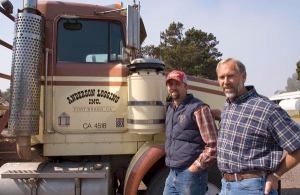 Mike didn’t want Myles to jump right into the business. “It would have been easy for me to head straight into it after high school,” Myles said, “but Dad wanted me to see other places and learn other things before deciding how to spend my life. He knew how much work is involved in this and hoped I would find something easier, but every time I was away all I wanted was to get back to logging. I really enjoy being out in the woods working with the guys. However, I’ve learned there’s a lot more behind the scenes to keep the business going, and that part is not as much fun.”
After graduating from Fort Bragg High School in 1994, it was hard for Myles to leave for Cal Poly San Luis Obispo. “I was not only leaving my family, but a larger logging family who had worked for Grandpa and Dad for 20 to 40 years. These were guys who taught me a lot, guys I looked up to.”
 Myles enjoyed college where he majored in Ag Engineering. When he was a senior, he and two friends wanted to build a tractor—from the ground up. “Each year, students in the department would build a sled to be used in tractor pulls. All prize money goes to student scholarships. The dean approved the tractor as long as we found sponsors to cover the cost.” Myles and his buddies were often in the machine shop until two or three in the morning. “We got to know all the campus cops. A woman cop sometimes brought us pizza.” Over the past 18 years, the tractor has been driven by 70 different people in 300 pulls.
After graduating from Cal Poly in 1999, Myles attended UC Davis where he earned a Master’s degree in Biological and Agricultural Engineering with an emphasis in Forestry Engineering. He returned to his logging family and went back to the woods.
“Dad let me do the jobs I wanted, but he also had me learn how to run the business. Much of our work is done through competitive bids, but sometimes we negotiate a job. Negotiations are when we work with a company to agree on a price. This is a lot harder than submitting a bid, but my education helped me understand our cost structure and how to do this successfully.”
 During the logging season, Myles routinely works 13-hour days. “The season used to be about seven months, but now it’s often eleven. Since the recession, logging capacity has shrunk. In order to fulfill the needs of the mills, our seasons have gotten longer. The ability to work during the winter has always been there, however regulation requires rocked roads. In the past, landowners haven’t wanted the additional cost that brings to the process.”
Road work is done alongside logging in the summer. Yarding (where logs are picked up and stacked) and loading (onto logging trucks) are done in the winter when rocked roads are available.
With 100 employees, Anderson Logging is one of the largest employers in our area. “In the past, we could count on our guys coming back each spring. Sometimes I’d pull up to the office to find strangers suited up in hard hats and boots ready to go to work.” This is no longer the case. “We’ve been shorthanded for the past five years. These are good jobs with benefits. I don’t understand why people don’t want to work.”
 Myles isn’t the only one in his family who works hard. He’s married to Stacey, a dynamic young woman who he knew in high school. They reconnected in 2003 when her son Wyatt (by a previous relationship) was two years old. Their son Lane was born in November 2006.
Four years ago, Stacey bought Makela’s Bootworks, a western outfitting store. She changed the name to Haywire and added apparel and accessories. “She loves people, clothing and horse stuff,” Myles said. “It’s worked out well for her.”
Having grown up a 4-H kid, animals are important to Stacey, and she’s passing this passion onto her sons. She’s been the community leader for 4-H over the past 10 years.

Wyatt
“We call our place the Funny Farm,” Myles said with a chuckle. Stacey has two horses (she’s an accomplished horsewoman) and Lane has a miniature horse named
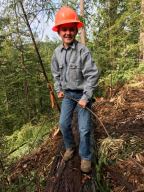
Lane
Tinker (short for tinker toy); Wyatt and Lane are raising heifers and a steer for 4-H.; there are ducks, chickens, and lambs. Lane raises pigeons and call ducks that he takes to poultry shows. In addition to their school and sports activities (football, track, basketball and baseball), the boys feed the animals and muck out stalls daily.
In addition to his long work days and farm duties, Myles is on the board of the American Logger’s Council (he was president last year). “We’re a trade association made up of logging company owners from 32 states. Once a year, we go to Washington DC and spend three days meeting with members of congress to educate them on our sustainable logging practices. We’ve grown to the point where people call us to get information on the state of the logging industry.”
Educating people, especially lawmakers, is the one aspect of being in the logging business that Myles doesn’t enjoy. “We have to fight so hard politically. There are many misconceptions about logging practices. People think we’re ruining the environment. If they could see a logging operation and the rules under which we operate, it would change their minds.”
Myles loves his job, especially when he’s out in the woods. “I’m helping manage a renewable resource and it’s the right thing to do. This job, if managed correctly, can be sustained forever.”
***
Shell Rotella did a short documentary on Myles for its” Unsung: Hardworking Series.” You can watch it here: https://www.youtube.com/watch?v=xUOZankXvoc
 When Josh’s girlfriend Lia Wilson told me what he does for a living, I simply had to meet him.
 Josh worked three part-time internships. He monitored the news and developed press kits for Environmental Media Services, a non-profit environmental public relations firm. He worked for filmmaker John de Graaf in coordinating the first Equinox Environmental Film Festival (later named for Hazel Wolf), soliciting in-kind donations and arranging other details. At
  In August 2011, he moved to Berkeley and became a private investigator with the Mintz Group, a multinational firm. A friend referred him, but he got the job because of his law office and writing experience. “We conduct a variety of investigations, none having to do with cheating spouses.” He laughs. “We focus mainly on three areas: due diligence, including extensive background checks on candidates for high level corporate jobs, and background checks prior to business deals; disputes, which means uncovering whatever it is lawyers need to know for a given lawsuit; and anticorruption. Under the Foreign Corrupt Practices Act, it is illegal for American companies to pay bribes to win job bids in foreign countries. Sometimes companies will contact us to investigate the practices of their employees abroad. We have offices in Asia, Latin America and Africa, as well as the U.S., Canada and London.”
 It Happened at Purity