Solution Architect

While shopping at The Purity recently, someone (who shall remain nameless, but is my only family member currently residing in Fort Bragg) called me a control freak because I suggested that he shouldn’t buy a bag of pork rinds to satisfy his whining need for a snack. “They’re not good for you and they smell like farts.”

This is the one-millionth time I’ve been labeled as such (I have a clicker on my belt) and I’m still not entirely certain what it means. I looked up the definition on Wikipedia: “In terms of personality-type theory, control freaks are very much the Type A personality” blah, blah, blah.

As a Type A personality, I get a great deal accomplished and successfully spur others into action (that is, until they stomp their feet in the middle of The Purity and start crying and calling me names).

My belief is, if you’re going to tell me your problem, you’re asking me to take control and find a solution. Otherwise, why would you tell me? Why would I listen? At a recent appointment, my therapist gently suggested that this approach is devoid of compassion. Sometimes people need to talk or do things without hearing my opinion.

Driving home, I was formulating a plan to fire my therapist when my son called.

I told him, “A member of our family (who shall remain nameless, but is the only one besides me who currently resides in Fort Bragg) called me a control freak.”

“I dialed the wrong number,” he responded. “I meant to call the Solution Architect on my project.” Demonstrating another stroke of brilliance, he hung up.

Solution Architect? I was intrigued.

According to Wikipedia, “A Solution Architect is a very experienced architect with cross-domain, cross-functional and cross-industry expertise.”

What a perfect way to describe my skill set: very experienced at inflicting my opinion on the way others should run their lives with all of my cross-blah, blah, blah expertise.

On the website www.glassdoor.com, there is no job listing or salary compensation for Control Freak. However, the median salary for a Solution Architect in the San Francisco Bay Area is $108,000.

  • 24-hours in a day minus 8 hours for sleep = 16 hours x 365 days = 5,840 Solution Architect hours/year.
  • $108,000 divided by 5,840 hours = $18.49/hour
  • That’s $18.49/hour more than I make as a Control Freak.

As a newly-minted Solution Architect, I will no longer dispense advice for free. The billing clock starts when the whining starts.

But I thought about my therapist’s words and another idea entered my cross-functional brain. When people share their problems, I can shut my mouth—actually keep my opinions to myself.

This will be difficult and require scientific intervention.

I began to formulate a compassionate-pose lipstick that contains glue and doesn’t cause cancer in laboratory rats.

When someone starts to tell me their problem, I’ll take the tube out of my purse, dab a bit on my top and bottom lips, and smack them together in a kindhearted smile. This will prevent me from uttering anything more than “Um-huh.”

But the lip glue development is proving difficult. Lucy, my newest lab rat, isn’t fond of lipstick. Yesterday, after I boiled up another experimental batch, I showed her its deep fuchsia hue and she ran off. When I finally caught her, she bit me several times as I applied it to her lips.

After completing my first round of rabies shots, and waiting to see if Lucy developed cancer, I realized I should heed my therapist’s advice. After all:

(1) My belt clicker doesn’t count past one million.

(2) My friends haven’t paid their Solution Architect invoices and have stopped inviting me to coffee.

(3) Lucy’s getting quite randy. (Fun fact: Webster’s Dictionary defines the term as “a coarse, vulgar, quarrelsome woman.”) She struts about the maze with her pink lips like she owns the place. It’s time to return her to the wild where she can wreak havoc on her own kind.

When you see my lips turning blue while being pressed together between a thumb and forefinger, know that I’m sincerely trying to stifle my control freak tendencies and keep my opinions to myself. Um-huh, I really am.

Meth Head Comes A-Callin’

Voted Fort Bragg’s Fun Couple by The Purity patrons for five years in a row, Gary and I ramp things up on Friday nights by challenging each other to stay awake past 9:00. I usually win. Gary slips into a snoring coma in his easy chair about the time 20/20 gears up.

On this particular Friday night, a knock on the door at 9:30 sends a shock wave through my heart. What the hell?

I turn on the porch light. The door’s top quarter panel is leaded glass and I can see a young man standing on our porch. I recognize him as a former high school classmate of our son. It’s rumored he’s a meth addict. I have not seen or spoken to him in at least six years. I keep the door closed.

“Are you Harrison’s mom?” he asks.

“Yes. And who are you?” (Pretending I don’t know him makes me feel like a shrewd detective.)

“I’m Fred Murphy.” (Not his real name.)

“What can I do for you, Fred?”

“Rita threw me out and I need $12 for a motel room.”

Twelve dollars? Such an odd figure. Maybe a hit of meth costs $12. I don’t know. In retrospect, if he’d asked for $20, I might have given it to him. I’ve never had anyone ask for $12.

“I can’t help you, Fred.” I remain detective cool and collected.

“But Rita threw me out. I don’t have anywhere to go. I’ll have to sleep in my car if I can’t get $12 for a room.”

“I can’t help you, Fred.”

“It’s only $12. You’ve got $12 don’t you?”

I’m growing more than a little annoyed by his persistence.

A special note to meth heads: You do not want to mess with a menopausal woman. She, like you, probably hasn’t slept in several days. She, like you, is probably not feeling rational. She seriously hates anything that stands between her and the potential of a good night’s sleep. When you show up on her porch at 9:30 at night, you’ve definitely lessened that potential and have put yourself in grave danger.

“You need to leave now, Fred.”

“But—”

“Now! Leave now!” I’m a real bad ass, my wits drawn taunt, a commanding edge to my voice. Back off, son—there’s no telling what I might do.

I shut off the porch light and tiptoe into my dark office. I peer out the window and watch him move slowly down the stairs and along the walkway. At the gate, he stops and turns towards the house.

I duck down and grab the phone, prepared to call 9-1-1. My heart races and my breath comes in short gasps. Piddle leaks into my pajamas.

I slowly raise my head above the window sill and watch him get into his car. I wait until he drives away.

I race to the living room. “Gary!”

“Huh? What?”

“Fred Murphy was just here asking for $12.”

“Who? What?”

Fred Murphy! He used to go to school with Harrison. He’s now a meth head.”

“Oh him,” Gary says, as in no big deal. “Why are your pants wet?”

“He asked for money!”

“He’s gone now, right?”

“Yes, but he wanted money for meth!

“Call the cops.”

I’m certain the cops won’t do anything more than what I did—with the exception of peeing their pants.

They’d probably refuse my request for 48-hour surveillance even though I fear retaliation in the form of Fred breaking in, tying us up, setting the house on fire, and letting our bound bodies fry to a crispy crunch.

I change my pajamas and go to bed, but don’t fall asleep until well past midnight, setting a personal best record in the Friday night challenge.

My Huckleberry Friend

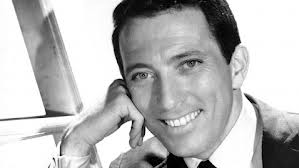
On Tuesday, Andy Williams died at the age of 84. To me, he’ll always be the handsome crooner who offered up sweet pabulum to my young, chaotic life each week in the form of the Andy Williams Show.

Yes, that’s me on the far right, the 1968 Claudine Longet lookalike.

In the sixties, he married the darling Claudine Longet. As she grew in popularity, my friends and I tried to imitate her doe-eyed looks and sweet soft voice, stopping just short of the French accent. (French was not widely spoken in Spokane, Washington.)

Moon River was Andy’s theme song. For a brief time, it was also mine.

Pupils in my third grade class were offered the opportunity to learn how to play the violin. The smarter students declined. I readily accepted. Why? I do not know. Every Saturday morning, five budding violinists from Franklin Elementary gathered with a larger group from two other elementary schools. I learned how to tune strings and apply resin to my bow. I also kind of learned how to play the thing.

We were required to practice an hour a day. To my young ears, I was a maestro. To the ears of my four siblings, I was a set of fingernails scratching on a chalkboard. They’d shout at me to stop. Defiantly, I’d continue to play in our cramped upstairs hallway, frequently begging my overburdened mother to intervene and kill them all.

By fourth grade, our violin group had mastered Farmer in the Dell, Lightly Row, and Three Blind Mice. We were deemed capable to train for the spring citywide concert. We would perform Moon River.

Each time I played that song, I envisioned standing by a river on a cloudless autumn night, the full moon reflecting on the water’s rippling surface. I fantasized that Andy was my father; he crooned that song to me each night as I fell asleep.

(A few years later, after Claudine dumped him, I imagined he could become my husband—either him or Mick Jagger. This was cause for many internal debates until I reached high school and Andy was no longer cool, but Mick had grown even cooler.)

I did not put in anything close to the hours of practice required to be prepared for the spring concert. How could I? The idiots I lived with did not appreciate orchestral music. They did everything they could to interfere with my practice sessions. I’d fight off the three younger ones by threatening to stab them with my violin bow, but was no challenge to my older brother who would eventually sock me in the arm, rendering me handicapped.

In the car on the way home from the concert, my mother said, “When the bows of the other kids’ violins went up, yours went down, and vice versa.” She chuckled.

I sat in the back seat brooding, gazing out the darkened window at the full moon, and making the bitter decision to give up the violin.

Long ago, Moon River made Andy Williams my huckleberry friend. It makes me sad that he, like so many others of that generation, is gone.

Hoarding

When “Hoarders” premiered on A&E, it caught my attention. I love to see how other people live, especially dysfunctional people. It makes me feel better about myself, which saves me thousands of dollars in therapy.  However, I wasn’t prepared for how nauseating it felt to witness the conditions under which hoarders live. I gagged when a mummified cat was pulled out from under several feet of rubble.

With the help of our housekeeper, Carrie, we keep a tidy home. It’s not so sterile that brain surgery can be performed, but I’m fairly certain there aren’t any cat mummies lying around.

Our detached garage is another asset in controlling much of the house clutter. Into the garage goes holiday decorations, planter boxes, household sundries (cleaning products, toilet paper) and anything else that I don’t know where to put. The garage is conveniently located several feet from the house, making it easy to ignore.

A few weeks ago, I had to retrieve wrapping paper and ribbon from a shelf out there. I climbed over a pile of items to reach the gift wrap, balancing one foot on a suitcase and the other on a case of toilet paper. The load began to shift. I was barely able to scramble to solid ground before it collapsed.

I stood for a moment, evaluating the mess. For the past decade, the garage has morphed into a navigation challenge worthy of one of those outrageous Japanese game shows. I reasoned that the obstacle course (along with the burned out light bulb) is important to keeping me alert and agile. I must watch my step, and feel my way through the dark.

I asked myself, “What would I say if I saw someone else living like this?”

I would say they were a hoarder.

I do not like to think of myself as a hoarder. I like to think of myself as a professional woman who, in her spare time, likes to hang out with family and friends, go to the gym, sew, and knit. I simply do not like to do domestic chores.

I hired a young friend to help me organize the garage. At the end of the day, I asked, “I wonder how many cans of paint the average American household stores in a garage?”

I’m hoping the answer is 85 because that’s how many cans of paint were hiding in mine. (This does not include the bag of 20 bottles of craft paint and one can of spray paint.)

Oh my God. I’m a hoarder.

In my defense, most of the cans are quart-size, and 24 are essential for touching up existing colors inside and outside the house. The remaining 61 accumulated over the past 10 years. I’d complete a project and put the can into the garage as the first step in a plan to donate it to local theater productions or take it to the HazMobile for disposal.

But you know how it is (or maybe you don’t if you’re more organized and don’t have any friends): a new painting project popped up and another paint can was added to the forgotten garage collection.

Within a week, I’ll hand the cans over to the HazMobile and I vow—listen to me, I vow—to never put another item in that garage that won’t be used within a year. (I just heard the Christmas decorations issue a sign of relief.)

I’m fairly certain that one of the steps in recovery is public admission of the wrong I’ve done. So here it is—I admit it. I once hoarded 85 cans of paint. Take it and feel superior.

I wish I could say that my organized garage has filled me with serenity. In truth, it’s thrown me into a case of post-traumatic stress syndrome. I enter, ready to navigate the landmines, but the landmines are gone. The open space, illuminated by the bright light bulb, feels too expansive. The neatly stacked shelves and hanging garden implements watch my every move. I run to the car and lock the doors, anxious to get away.

Stayin’ Alive

I’m sitting in my car parked in the strip mall lot in front of the health food store. A large pickup pulls into the space across the narrow asphalt behind me, adjacent to the movie theater. I’m waiting, impatiently, while the very busy Los Gallitos Restaurant takes 20 minutes to prepare my “to go” burrito.

About ten minutes after the truck occupants enter the movie theater, the vehicle alarm goes off. Honk. . .Honk. . .Honk . . . .

I’m hungry and tired. I do not need to be further annoyed by a vehicle alarm.

I look in my rear view mirror for the truck owner to come out and stop the noise. By now he is ensconced in the soundproof cinema watching movie trailers with a bag of popcorn on his lap.

Honk . . .Honk. . .Honk . . . . After two minutes, another sound mixes with the honks—a flat blasting sound—to create a sort of rumba pattern: honk. . .blast. . .honk. . . .

I absently keep time to the rhythm by tapping my thumbs on the steering wheel.

In my rear view mirror I see my two favorite street people—Hans and Franz—appear on the sidewalk next to the theater. The rumba beat of the vehicle alarm draws them.

They reach the side of the truck and, like children, spontaneously burst into dance. They throw their arms up, pointer fingers to the sky in John Travolta versions of “Saturday Night Fever.”

As they dance and whoop, the sun pauses its descent into the vast Pacific Ocean, bidding farewell to the western hemisphere and signaling mid-morning to Chinese factory workers as they toil to make crap for American consumers.

One final beam travels over the Fort Bragg headlands, intensifying as it moves through the strip mall parking lot to focus an amber spot of light on the unbridled joy of Hans and Franz.

Moments later, the light dims. They stop and resume their walk: Hans with his confident swagger and Franz with his dignified step.

They have banished my annoyance and replaced it with happiness.

[Whenever you need annoyance replaced with happiness, go to: http://www.youtube.com/watch?v=I_izvAbhExY]

Got Pot?

There are two men in front of me at The Purity checkout line on a Tuesday afternoon—two of the legions of young adult males with no visible means of employment. Pot growers? Occasional construction workers? Drug dealer?. Who knows?

My mother is obsessed with reading bumper stickers. Since I am no way like my mother, I obsessively ignore bumper stickers. However, wear a tee-shirt with something written on it and I’ll follow you around until I can decipher what it says.

One of the gentlemen is wearing a black tee-shirt with bold white lettering. He stands sideways to me, but as he moves, I see the “F” word.

He picks up his soda and chips, turns to his friend, and all the words are revealed:

I will never move away from here.

I Want Some of That

It’s Easter Sunday and I’ve just had my taxes done (the only day my preparer and I could find in common). I’m self-employed and fairly accurate when it comes to estimating my liability, but was shocked to learn I owe hundreds of extra dollars.

I’d forgotten that our youngest had graduated from college in June 2011, gotten a good paying job (damn her!), and we aren’t entitled to those juicy tax credits. I’m pretty much hating life when Wilson reminds me it’s time for our walk.

It’s Fort Bragg. It’s Sunday. It’s Easter. It’s 3:30. You could lob cannon fire down any street in town and no one would be harmed. I’m looking forward to a peaceful outing with my dog.

We head west on Fir Street. At the Episcopal Church, we encounter a couple walking south along Franklin. The woman looks like a gypsy—black peasant top rolling off her shoulders, poufy black skirt hanging in layers. Bracelets—lots of bracelets. Black hair pulled into a sloppy bun to reveal a neck tattoo. The man is handsome under a grizzled layer of thick tanned skin and dusty clothes.

“HAPPY EASTER,” the woman shouts.

I owe hundreds of dollars in taxes. This is not a happy Easter. However, I do my best to return her greeting.

“This is my dad.” Her laugh is a cackle.

His chuckle is more of a growl. If a lion could laugh, this is what it would sound like.

I take a long, hard look at them. I suppose he could be her father if he was five years old at the time of conception.

He gives her a sexy glare.

She swishes her skirt and offers a saucy flip of her head. She cackles again.

Barf.

They take up position behind Wilson and me as we walk south on Franklin. She tells the world, “I feel great . . . just great! This is the happiest Easter ever!”

She’s euphoric, the kind of euphoric I get when I combine the Barefoot Contessa’s Outrageous Brownies with Alden’s Organic Vanilla Ice Cream and a cup of strong coffee.

I wonder about her menu for euphoria. I want that happiest Easter ever feeling to unravel the tangled knot of IRS debt squeezing my heart and lungs, reducing my breath to shallow gasps. I want euphoria now.

A social worker once told me that some women in this town trade sex for drugs. I wonder….

They are walking from the railroad tracks that run through the north end of town, past the cemetery and into the wilderness. One doesn’t have to go far to be in total isolation. All manner of whatnot goes on in that area, the details of which I don’t want to know. There are concealed places that might be ideal for trading sex for drugs or drugs for sex.

I turn my head and take another look at the Grizzly Guy….

Nope.

I’ll stop by The Purity and pick up Alden’s Organic Ice Cream and make the brownies when I get home.

Take & Bake Pizza

Wilson and I are on the homestretch of our 20-minute walk when we encounter a man on Alder Street where the sidewalk meets the alley that runs behind The Purity. He’s stout and bearded, wearing a stained white tee-shirt and jeans, and carrying a plastic grocery bag in his right hand. A boxed frozen pizza is held like a shield in his left hand. He smells of distilled alcohol.

We come to a halt. During the awkward moment of determining who has the right of way, he pushes the box into my line of vision. “WANT SOME PIZZA?”

I smile. “No, thank you.” Wilson and I begin to move past him.

“IT’LL BE PIPING HOT IN 40 MINUTES.”

“Thank you so much, but I’m not hungry.”

“Well . . . all right.”

“Have a good day.”

“Beautiful dog ya got there.”

Wilson is 14 years old and certainly beyond the prime of being described as beautiful. We’ve always referred to our lab/border collie mix as “funny looking.” But it makes me proud that someone considers my ancient dog beautiful.

“Thank you,” I say.

“SURE YOU DON’T WANT SOME PIZZA?”

Is this a hit on my female person? Is he only complimenting by dog’s beauty in order to sweeten the pizza invitation?

If only he’d been holding a Cyrus O’Leary’s chocolate cream pie ($2.99 at The Purity; located in the dairy section), the outcome might have been different.

I’m not a fan of pizza.

Wilson and I head home.

Goodbye First Grade

Our youngest, Laine, left for college in the fall of 2007. Over the previous months, I’d become adept at eliciting pity from anyone who didn’t run the other way when they saw me. Laine’s going off to college; I’m so sad; say you’re sorry; tell me it’ll be okay even though I know it won’t. After 21 years, I don’t know how to live without children.

Kim Mertle did not run fast enough, which allowed me to capture her in The Purity. She suggested I might find comfort through volunteering in her first grade class.

What a great idea! Since my own kids were leaving me, I’d replace them with other people’s kids. I did not have to surrender to the desolation of Empty Nest Syndrome.

Initially, I think Kim worried about how my fragile state might affect her classroom. She assigned me to a corner and sent individual kids to read to me.

A darling, cherub-faced child would read with a halting cadence. I remembered when my own children first learned to read, how Gary and I would sit next to them and marvel at their recognition of the written word. They were all grown up now, in college, far away.

When confronted—“Are you crying?”—I’d tell the child, “Me on a Map is such a sad story.”

Eventually, Kim released me to the class at large and let me assist students with their worksheets. I was given a purple Awesome stamp and had the power to brand papers with my approval. It was purple-ly awesome. Sometimes I would use a colorful felt-tipped pen to draw a star on a finished paper. My unparalleled, star-drawing talent never ceased to impress.

I went on every field trip and attended every class party. I was their once-a-week angel and they were my darling babies. I fell in love with every one of them. On the last day of school, I cried.

The following year, I was given the additional responsibilities of checking in homework and presiding over work stations. I was a bit annoyed by this class at the beginning. We’d gone through this material last year and these new kids weren’t getting it. What was wrong with them? Even though these were freshly minted kindergarteners, I found the repetition of last year’s lessons rather boring.

Again, I participated in field trips and parties. Again, I cried at the end of the year.

I carried each year’s child in my heart, missing them. I wondered if they thought about me and how I helped and encouraged them. Every now and then I’d run into a former student and was delighted to see them.

They’d look at me like I was stranger danger. “You remember me from Mrs. Mertle’s class don’t you?” Without fail, none of them did.

I was stunned. I gave these kids the best two hours of my week, every week for an entire school year. I cried when they read to me. I cried.

This was a humbling experience. However, I relearned that children are creatures of the moment. At that moment in their lives, I was important; afterwards, not so much (actually, not at all).

I began volunteering to fill a void in myself. I evolved into recognizing that my role was to be of service—to the teacher and the students. I carried on, still enjoying it, but with less emotional attachment.

Over the following three years, I attended fewer field trips and parties until I attended none at all. I stopped crying at year-end and looked forward to summer break. This past year, I had an inkling of burnout when a girl handed me a snotty tissue and I said, “Why are you trying to give this to me?”

“So you can throw it away.”

“Do I look like your mother?” Even though my tone was lighthearted, she looked puzzled by the sarcasm and reluctantly threw the tissue away. I was ashamed.

In April, Kim announced she would teach at the middle school in the fall.

What about me? How was I going to get my kid fix? A couple of hours passed and I realized I no longer need a kid fix. I had raised kids for 21 years: volunteering in classrooms, going to sporting events, organizing parties, and helping other children. My addiction has run its course.

I am content with my empty nest.