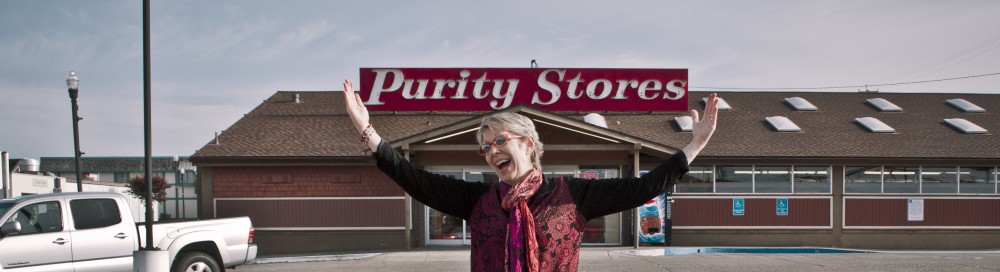

The receptionist looks like she’s ready to tell my friend—let’s call her Kate—some terrible, awful, apocalyptic news like her colonoscopy appointment has been canceled because the raging wildfires in Sonoma and Mendocino counties prevented the doctor, who lives in San Francisco, from driving to Fort Bragg.
Kate blurts out the “F” word—not because she’s upset with the bearer of the worst news she’s received in a long time, nor because the doctor wasn’t willing to risk his life to save her the horror of repeating the colon prep, but because yesterday she’d thought once or twice about contacting the hospital to verify her appointment. Her nutritionally deprived brain prevented her from following through.
She wants to collapse to her knees and scream, “Noooooooooooooo!” She wants to pound her forehead into the carpet until security arrives to escort her to the preemie ward where grandma types comfort fussy babies along with people whose colonoscopy appointments are cancelled at the last minute. A grandma will gather her into soft arms, rock her gently back and forth, pat her back and whisper, “Shhhhhh…at least you have good health insurance.”
The receptionist explains that because the local phone service is down, the hospital is unable to contact patients.
***
A few months previously, Kate showed true Big Girl Grit when she scheduled that appointment. Given she’d experienced two colonoscopies and knew the torture she’d be subjected to, this was a very brave thing indeed.
 If you’ve never had a colonoscopy, you may not understand why the term torture is associated with it. This applies to the day before. The patient is allowed to ingest only clear liquids, which by mid-morning sets off a primal alarm in the brain—the process of starving to death has begun. By mid-afternoon the brain partially shuts down and the patient wanders zombie-like through the rest of the day. She occasionally snaps into reality and tries to keep the whining under control by reviewing all the things she should be (but truly isn’t at that moment) grateful for: family, friends, shelter, blah-blah-blah, and good health insurance.
As the sun begins its descent into the Pacific Ocean, the day is finished off with a cocktail of Drano and Liquid Plummer disguised under the label “Suprep.” Kate refuses to detail what this does to the human body, and will only say that body must remain within sprinting distance of a toilet.
 After a fitful sleep, the following morning begins at four o’clock with another round of the cocktail. Kate wants to cry, but remembers there are a bunch of people in the world suffering a great deal more than her. She tries once again to concoct a gratitude list, but cannot think of a single thing.
At seven o’clock, debilitated and literally empty, she says to her husband—let’s call him Gary—and her dog—let’s call her Lucy—that the only thing keeping her going is the promise of drugs administered at the hospital. Not much of a drug user, Kate was pleasantly surprised by the gentle euphoria they provided on her two previous colonoscopy occasions. They nearly made the hours leading up to the procedure worth it.
Kate’s friend—let’s call her Marcia—picks her up at seven forty-five and listens to Kate pretend to put her misery into perspective in light of the devastating inland fires. Marcia escorts her into the hospital to get an estimated time of when to return.
***
Kate apologizes for saying the “F” word. The receptionist kindly says if she were in the same situation that is exactly the word she would choose.
As Marcia drives her to Homestyle Café for the best breakfast ever—two eggs, smashed fried potatoes and biscuits—Kate suspects the cancelation of her procedure is some kind of karmic due or payback for her sins. She’s not religious, but was raised by a former Catholic (once a Catholic, always a Catholic). Whenever something goes awry, she can never fully shake feelings of God’s retribution for her bad behavior.
Let’s see—what could it be this time? Her bossiness when working with a group? Her whininess when things don’t go her way? Her petty judgement of others? That the previous day she was dull to the pain of those who lost so much in the fires? Well now she’s simpatico with that pain. There you go karma or God. Point taken; you win.
Kate leaves breakfast expressing gratitude for solid food, family, friends, her dog, and good health insurance. The words ring hollow with the dread of having to go through the entire colon prep experience again—hopefully before the end of the year so she doesn’t have to pay a new deductible.
Marcia drops her off with a note of positivity: “Schedule it in December. You can give yourself a clean colon for Christmas!”
 If you’re walking east along the 200 block of Redwood Avenue, you’ll notice a difference in the
 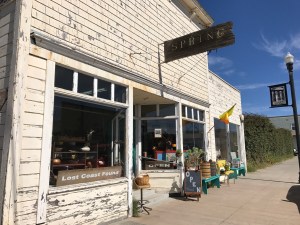 Part of this renaissance is due to the opening of the vintage shop Lost Coast Found, housed in the same location and owned by Megan Caron—a homegrown girl who returned after living in Petaluma for 16 years. “When Larry died [in 2009], he left the building to Heather Brown, a well-known Canadian artist,” said Megan. “In exchange for reasonable rent, I help out with the museum.
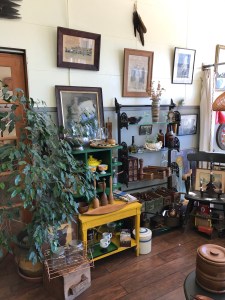 When Megan speaks of something she’s passionate about—her store, the museum, kids spending too much time on screens, or the lack of housing on the coast—her hazel eyes blaze. She’s articulate and quick to laugh, flashing a sly look whenever she makes fun of something or herself. As I listen, I understand why Fort Bragg once had a hard time holding onto her intense energy.
 Over the next 16 years, Megan and Ben settled into life in Petaluma. They bought a house and had two sons—Addison (9) and Arias (5). “As the boys grew older, I became uneasy about raising them in a suburban environment where there’s a disconnect with nature. I drove 15 minutes just to go to the park. I regularly took them to Fort Bragg where they could play in the forest and we could be at the beach within five minutes. They seemed happiest in the wild.
 During that time, Megan looked for a storefront in Fort Bragg. In November 2016, she was walking by the Larry Spring Museum and saw a slip of paper with Heather Brown’s phone number written on it. “I called and within twenty minutes, I had the keys.”

 It Happened at Purity