A-Fib

In July 2025, I suspected something was wrong with me. For years, I’ve exercised regularly, yet found myself quickly running out of steam. After climbing the stairs in my home, I’d have to sit on the edge of my bed to catch my breath. In my defense, the staircase is a steep Victorian and not easy to ascend. When we first moved here, I dubbed it the “Thigh Master” after the exercise product Suzanne Somers promoted in the nineties.

Another thing I noticed was when I exerted myself—like going up the stairs or on my daily walk—I could feel my pulse throbbing in my neck. At an acupuncture treatment around that time, he expressed concern that my pulse seemed erratic. Over the years, my nurse practitioner has commented it was irregular at times. I dismissed their concerns. My father had an irregular heartbeat and lived to be eighty-one. I attributed mine to genetics.

As much as I pushed to increase my stamina, the weakness only worsened. One morning in September, I headed out for a walk, got a half block, and was forced to turn around because my heart beat so frantically I could barely catch my breath. I believed I was having an anxiety attack, and took a lorazepam when I got home.

 Even with all my excuses and denial, I knew this was something that needed to be addressed. I thought about what I’d advise another person and the answer came back that I’d scold them into seeing a doctor.

But here’s the thing—I live alone and at the time my 12-year-old Lucy-dog wasn’t doing so hot. I didn’t have the luxury to discover some heinous illness that would land me in the hospital for God knows how long.

In early December, I had to have Lucy put down. Shortly afterwards, I made an appointment with my nurse practitioner who referred me for an EKG at the hospital. Sure enough, something was wrong. I had arterial fibrillation—or A-fib for short. It makes the heart’s upper chambers beat chaotically, reducing its ability to efficiently pump blood. I was warned it could cause me to pop a clot which would, in turn, give me a stroke.

 A week later, I had an echocardiogram that showed something amiss in the left part of my heart.

Goddammit!

I went to bed each night worried whether I’d wake up with my full faculties or drooling from the left side of my paralyzed face, unable to move. The following two weeks, as I let a prescription blood thinner do its thing, I texted proof of life to my sister Molly each morning. She was under strict orders to call if I hadn’t texted her by nine am. If she wasn’t able to reach me, she had to call 911. I gave her the backdoor lock code to pass along to the paramedics. I didn’t want to add a busted door to my list of worries.

To make matters worse, it was winter. Darkness prevailed and I mourned the loss of Lucy. I belly-flopped into the blues.

 Fortunately, I quickly got a referral to a cardiologist in Santa Rosa, a serious fella who didn’t waste time or words. I proudly reported that I walked nearly every day, worked out regularly, basically ate a Mediterranean diet, rarely indulged in processed foods or went to restaurants.

He furrowed his brow, flummoxed. “You don’t present as someone who should be having these issues.”

No shit, I wanted to say. Instead, I felt guilty over being such a disappointment—not only to him, but to myself.

Over a period of seven months, I went from taking zero prescription medications to taking six! December: Eliquis—a blood thinner. January: Metoprolol succinate—to bring down blood pressure—and Amiodarone—to keep the heart in normal rhythm. March: Entresto—a diuretic and reducer of high blood pressure–and Spironolactone—another diuretic. June: Jardiance–another diuretic.

I was humiliated and humbled. I’d prided myself on being robust for my age—at times even bragging about it. Suddenly, I was a pathetic mess.

It took a week or two for my body to adjust to each medication. Exhaustion, weakness, and impaired balance were the main side effects. I still experience these from time to time.

While I resented having to take so many pills, I tried to be grateful that the medication was intended to get me out of A-fib and fix that pesky thing going on in the left part of my heart. When this had not happened by early May, I was schedule for a cardioversion—or medical shock to the heart.

The only things that concerned me about the procedure were not being able to eat the morning of and having to travel two-plus hours to Santa Rosa. However, I’d heard from a fellow A-fibber that I’d be given a sedative similar to the one administered for a colonoscopy. I must admit, the only thing that gets me through the colonoscopy prep day is the promise of the next day when that dancin’ queen’s magic would cha-cha all my cares away.

On heart-shock day, my dear friend Kathleen picked me up at the crack of dawn and drove me to Santa Rose Memorial Hospital. As instructed, I checked in an hour early and was taken to an outpatient ward where nurses performed all kinds of voodoo, including an EKG to determine if I was still in A-fib.

I was.

A nurse asked if I had any questions.

I did.

“When do I get the sedative?”

“Not until right before the procedure.”

Well, dammit it anyway.

I now had time to obsess on what I’d read about the transesophageal echocardiogram part of the procedure where a tube would be inserted down my throat and into the esophagus to check for blood clots in the heart. What if I had a blood clot—or two? If so, they wouldn’t do the cardioversion, and maybe rush me into intensive care or helicopter me to UCSF Medical Center. As they raced me through the hallways, elbowing people out of the way, would they let me call my kids before I had a stroke and became incapacitated?

I was emotionally spinning by the time a tall, blonde Nordic nurse approached and introduced herself as the one who would accompany me to the procedure room. She was friendly, yet had a take no prisoners vibe. She reviewed my chart on a computer and asked if I had any questions.

I did.

“When do I get the sedative?”

“Right before the doctor does the procedure.”

Bummer.

She pulled a cell phone from her pocket, punched in some numbers, and said, “Where the hell are you? Your patient is waiting on you.”

Within minutes, a cardiologist I recognized as a partner in my doctor’s practice, rushed in, a big smile on his face.

The nurse—who was a good foot taller than him—declared, “Finally!”

He ignored her, took my hand, warmly, introduced himself, and explained what he’d be doing to me. By this point, I’d been seeing my cardiologist for five months and he’d never once ever smiled at me, nor exuded the least bit of warmth. He always looked as if he suffered ingestion while pondering the mystery of how I’d gotten my normally healthy self into this messy situation, and his requirement to figure it out.

My bed was wheeled down a hallway to a room that looked like a large storage area. Random pieces of medical equipment littered the perimeter. An aide hooked me up to an EKG, handed me a tiny cup of lidocaine, and told me to drink it. It was thick and minty, and I had no problem holding it in my mouth for the required thirty seconds before swallowing. This would numb my throat enough to tolerate the tube inserted into my esophagus. For the first time, I got scared. Would I be awake when that happened? I did not want to be awake when that happened.

The cardiologist leaned over me with his delightful smile. “Before doing the cardioversion, I’ll use this to check for blood clots.” He held up a skinny white tube attached to what looked like a digital thermometer.

I wanted to scream, If I’m reminded of blood clots again, I’ll become completely unhinged!

Instead, I asked, “When do I get the sedative?”

“I’ll give it to you now.” Nordic nurse injected it into a portal of my IV tube.

“Thank,” I started to say, but I didn’t get the “you” out.

The next thing I knew, I woke in the ward I’d started in.

“How’re you feeling?” asked the nurse who’d admitted me.

“Am I out of A-fib?”

“You are.” She gave me a smile.

“Woohoo!” I whispered. My relief was so great I could have jumped from the bed and done a lap around the ward. Instead, I savored chocolate pudding as I called my kids and my sister to announce the wonderful news.

Kathleen drove me home and made certain I got settled.

Aside from being unable to eat that morning, the entire process was painless except for a mild sore throat from the tube being shoved through it. The following day, my throat burned, making it too painful to eat solid food. Also, I had what felt like a mild sunburn on my chest and mid-back from the shock paddles. I pureed my food for a week and slathered aloe vera on my burns.

Friends asked if I felt better, but the answer was no, I didn’t. I hadn’t recouped my stamina and continued to take short afternoon naps. I then learned it can take four to six weeks to regain energy after a cardioversion. Over that time, my walks slowly increased from fifteen minutes to forty—sometimes fifty. I’m so grateful to have reclaimed a lifestyle I’d once taken for granted.

Unfortunately, A-fib is chronic. I’m out of it for now, but the cardioversion isn’t considered a permanent solution. There’s another procedure called an ablation that’s more invasive, but more successful in holding off a recurrence for a number of years. However, this is only considered after the cardioversion fails.

When I visited my cardiologist in early June, he didn’t scowl when he reviewed my chart, which allowed me to assume he was pleased with my results. He prescribed a blood test in July, a heart monitor in August, and said I didn’t have to see him again until September.

“Awww,” I quipped, “I’ll miss you.”

He grimaced.

“Have a good summer,” I said, smiling.

This got a tiny smile out of him, and he said, “You, too.”

This sparked a feeling of affection towards him. I think he wants to be warm and personable—he simply doesn’t know how.

Or maybe he just had gas.

Unlike all the other appointments where I’d call my fellow A-fibber friend to cry as I drove home, I flew out of there on a cloud of sweet gratitude and went to Alameda to snuggle my newborn grandson.
Ode to Joy

In late summer of 2024, my friend—let’s call her LM—and I took an afternoon walk on Fort Bragg’s South Coast Trail. She asked if I was still doing my solitary sunrise walks. I told her I did them nearly every day, and had begun offering snack packs to the street people I encountered. It made me happy to see someone smile when handed an unexpected treat.

A regular named Jim called me his “Cookie Lady.” I’d often find him sitting on the Redwood Avenue bus bench smoking a joint at six-thirty in the morning, a mug of milk-laced coffee resting by his side. He looked like a grizzled, chubby toddler, and his face burst with delight whenever he accepted my offered snack. We’d spend a moment together, looking east to marvel at the sunrise and wish each other a good day.

LM was impressed by my benevolence which, in turn, fluffed my tailfeathers and made me feel almost Mother-Theresa-like. Look at me being all kind and generous and shit. And all first thing in the morning—even before I’d brushed my teeth.

As LM and I ended our walk, we spotted a woman standing at a picnic table near the headlands of the Noyo River. Her oversized drab green parka hung to her knees, covering most of an ankle-length flowered skirt. Her long brown hair was streaked with grey, held in place against the breeze by a dirty beige cowgirl hat. A cart beside her was piled high with bulging black trash bags.

LM—who owns a local storefront—recognized her. “She sometimes comes in and isn’t like the other street people I’ve encountered. She’s polite and seems well educated.”

My benevolent alarm sounded. I got all excited and said, “I have snack packs in my car. Should we give her one?”

LM is the most reserved person I know. I was shocked when she enthusiastically said, “Sure.”

I crossed the parking lot to retrieve a pack of Ritz-Bits. LM and I—fortified by our do-gooderness—walked over to the woman who by that time had spread a red and white checkered tablecloth over the picnic table.

“Hi,” I said, my smile wide and genuine.

She looked up, narrowing her eyes and pressing her lips together into a menacing line.

Uh-oh.

Maybe approaching this woman hadn’t been such a great idea. But I’d initiated contact and had to follow through to show LM that it can be a fulfilling experience to interact with the less fortunate.

Holding forth the Ritz-Bits, I said, “Would you like a little snack?”

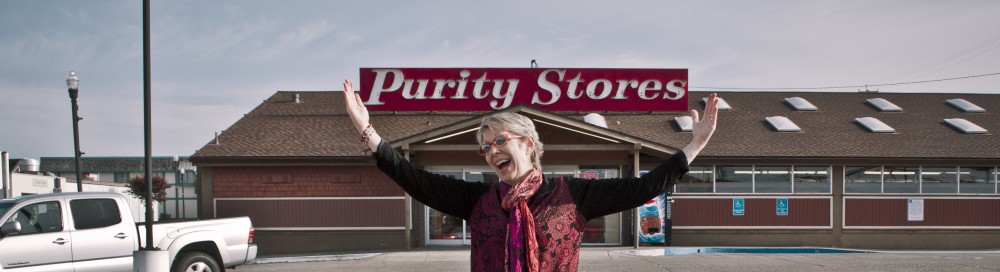
“Why would I want that?” she said, her face a full-blown scowl. “I just went to Purity and bought two boxes of Ritz crackers.” She fished inside one of her trash bags, pulled them out, and placed them on the table.

Oops!

“But these are Ritz Bits with peanut butter,” I countered with great enthusiasm.

“What are you selling?” she growled.

“I’m not selling anything. If you don’t want them, it’s okay.”  

“I DON’T,” she yelled in a most malevolent way.

LM, cowering behind me, leaned into my ear and said, “She’s not the woman I thought she was. I think we should leave.”

As we turned, I noticed a middle-aged minstrel playing a guitar at a picnic table about twenty-five feet away.

“Come,” I instructed Laurie. I was determined to show her my giveaway plan was a noble cause.

As we walked over to him, Malevolent Woman, yelled, “WHAT ARE YOU TRYING TO PULL? GET THE HELL OUT OF HERE!” and other heinous things I can’t remember.

The minstrel paused in his strumming and graced us with a most beautiful smile. Surely he would accept our act of kindness.

“DON’T FALL FOR IT,” Malevolent Woman hollered. “THEY’RE DOING PRODUCT PLACEMENT!”

“Hi,” I said to the minstrel, holding out the Ritz-Bits. “Would you like a snack?”

He gently said, “No, thank you.”

As LM and I turned towards the parking lot, Malevolent Woman moved around her table, giving her closer proximity to us. “I TOLD YOU TO GET THE HELL OUT OF HERE! TAKE YOUR RITZ CRACKERS AND SHOVE THEM UP YOUR ASS!”

“Run,” I said to LM.

Fortunately, LM and I are quite fit, which allowed us to trot safely to our cars.

Malevolent Woman didn’t follow.

“Well, that was an adventure.” LM nervously giggled.

“It sure was,” I laughed, but suspect she’ll never agree to go on another one with me.

***

            So, you might wonder, how did this fiasco come about?

On the morning of the Ides of March 2024—the third anniversary of Gary’s death—I woke, as usual, at six o’clock. I stumbled to the kitchen, made a cup of coffee, and sipped it while sitting on the sofa. I shed tears as the significance of the date washed over me.

After my last sip, I took my cup to the kitchen. A glance out the window revealed the edges of an inky eastern sky beginning to lighten. With barely a thought, I pulled my winter coat over my pajamas, slipped on shoes, grabbed my iPhone, placed Air Pods in my ears, and stepped out the backdoor. I walked through the gate and took a right in the alley. A cold breeze slapped my face and made me question what the hell I was doing. I’d never gone outside at this time of day.

“Today is different,” something inside of me whispered. “Today you do.”

I opened Spotify on my phone and the song, “Sitting,” by Cat Stevens popped up.
Sitting on my own, not by myself
Everybody’s here with me
I don’t need to touch your face to know
I don’t need to use my eyes to see

I started to cry, yet continued walking. The song gurgled up all the grief I’d experienced over the loss of key family members over the previous three years—starting with my husband Gary’s death in March 2021. Then brother-like friend Jerry’s nine months later. My mother’s nine months after Jerry. And Jerry’s widow—our sister-like friend—Marcia’s death eight months after Mom. Interspersed among these were the deaths of my brother-in-law Jim and dear friend Karen.

Oh—and mixed in with all that mess was my sadness over recently making the decision to end a romantic fling. A fling I’d held high hopes for turning into a casual, yet sustainable relationship. An experience that eight months into it made me realize—for a number of reasons—that a short-term affair was all it could ever be. The breakup was very civil and amicable, but left me heartbroken. Another loss packed into a grueling three-year period.

Death. Loss. Grief. DeathLossGrief. Over and over and over again.

Goddammit!

That chilly Ides of March morning, I wept as I walked up the incline of my empty street. I watched the sky lighten to a rose and blue-gray as the sun inched towards the horizon, placing the Fort Bragg Middle School campus and the trees behind it in silhouette. I stopped and stood in awe of the simplicity, yet the miracle of this sight.

This might sound bizarre. Of all places on earth, Fort Bragg Middle School associated with a miracle? Middle schools are notorious for being places where hormones rise up to propagate armpit and genital hair, kill childhoods, and leave people traumatized for life.

But here’s the thing—if I hadn’t been outside that morning, I’d have been cloistered in my office, my focus held captive by financial news on my computer. I wouldn’t have stood across the street from a building I’d seen thousands of times, wouldn’t have known the cresting sun could bless it with such loveliness.

As I absorbed this beauty, the song “Sitting” reminded me, “Everybody’s here with me.” I deeply missed the people who were once central to my life, but at that moment, I felt them all—Gary, Marcia, Jerry, and Mom—wrapping me in comfort.

I wish I could say that a half hour of wandering allowed me to return home fully recovered from grief bullshit, but such was not the case. I did, however, feel some relief from letting go the tears that had simmered inside me throughout the days before.

The next morning at six-thirty found me outside again.

And I went out the morning after that and the morning after that and. . . .

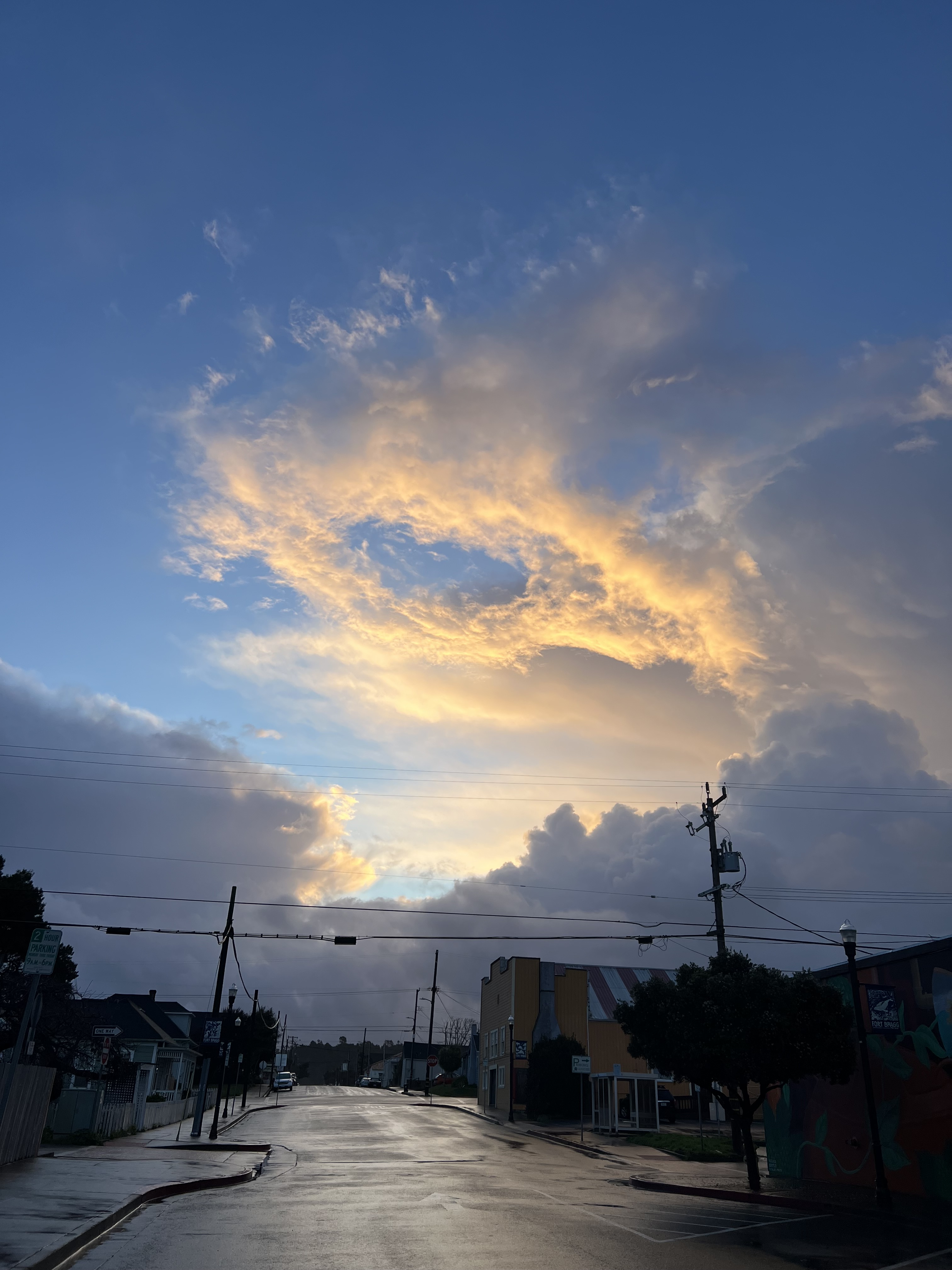
One stormy morning, as I walked between the rain squalls on an empty street, the rising sun beamed through a gathering of dark clouds, the brilliant rays imitating a Renaissance painting of heaven bursting forth upon the earth. I stopped and searched “O Come O Come Emanuel” by the Mormon Tabernacle Choir on Spotify. As my favorite rendition of this divine song played, I stood in the middle of the street and wept with gratitude for being given this sight. I don’t believe in heaven—and certainly not in hell—but I do believe in the mystical power of the universe, and at that moment it touched my soul.

After beginning this walking quest, I’ve rarely skipped a day. Each goes a long way towards easing my periods of anxiety and melancholy. They gift me the rare opportunity to be in the moment. I wander alone through the streets—me and my music—putting one foot in front of the other—over and over and over again.

Whenever I see a newspaper on the sidewalk outside someone’s home, I pick it up and toss it onto their porch. A year into these walks, I have three houses where I routinely do this. One is a couple blocks away. I’d recently learned the husband had been diagnosed with a terminal illness. Each morning, I pick up their “Press Democrat,” open their front gate, walk to the edge of their porch, and toss it as I whisper, “I wish you peace.”

I’m not telling you this to indicate I’m a saint. I’m far from it. But from my painful experience of watching my husband Gary deteriorate over a period of years and the trauma of the six wretched weeks leading to his death, I know—I know—the emotional devastation happening in that household. If I can provide a minuscule bit of relief—not having to navigate porch steps and out to the sidewalk to retrieve a paper—that’s what I’ll continue to do.

As my spring walks turned into summer, I began stuffing a couple of snack packs into my pockets to offer to any street person I encountered. Usually, though, I anonymously leave a couple on the Redwood Avenue bus bench, about a half block from the Hospitality House.

I’ve also begun placing tiny artificial birds in people’s yards. They’re bright and colorful and I order them in bulk online. I put one in my pocket before I head out the door. Initially, I clipped one on a bush or tree in the yards of people I know. When I exhausted those properties, I began allowing a yard to tell me if it needed a bird. It might be a home that’s well-manicured, where the residents take pride in maintaining their landscape. The bird becomes a seal of approval—a well done award. It might be a place so beaten down and sad that a colorful little bird is the only thing that gives it a splash of joy.

My morning walks are an unexpected gift. They allow me to experience setting moons, half-moons, quarter moons, you-name-it moons. Full moons so majestic they take my breath away. Sunrises through magnificent cloud formations. Ravens swooping about in pairs, warming up for a day of mayhem. Serenity—deep, soothing serenity. They make me feel like I’m getting away with something, but I ‘m not sure what. Maybe I feel I’m the only person on earth privy to witnessing such miracles.

Occasionally, I encounter forty-something-year-old women power-walking. They remind me of myself at that age—desperately trying to get a grip on life by speeding through it. I’ve come to realize that such scurrying about delivered me to where I am now—a place that allows me to pause, take a deep breath, and appreciate the dawning of each new day.

Three years after bearing the dreadful grief over the deaths of my loved ones, the universe granted me ways to conjure moments of joy. These moments are fleeting, but enough to sustain me to continue walking through this challenging experience called life.

California DMV

I knew my driver’s license was due to be renewed by my birthday in March of this year. What I didn’t know was that, at the age of 70, I forever lost the luxury to simply pay a fee to continue driving another five years.

In January, after receiving my renewal notice with this disturbing news, I went to the tiny Fort Bragg DMV office on Franklin Street, grabbed a free driver’s manual, took it home, tossed it on the kitchen table, and ignored it.

I went to the DMV website and found assurance that I shouldn’t worry about taking the written test. They don’t want me to fail. They sincerely want me to pass. To prove their point, they offer four practice tests with ten questions each. I easily passed them all. I searched the internet for websites that offer free practice tests, which I found in abundance. These were more challenging, but I passed three of them a day for a week.

On Tuesday, February 6th, I had a free afternoon and felt cocky enough to go to the DMV and get the ordeal behind me.

When I was last there six years ago to exchange my ordinary license for a Real ID, they had a system where you pulled a number from a dispenser thingy, took a seat, and waited for your number to be called. This time, the dispenser was nowhere to be found and I was greeted by a white poster board with handwritten instructions to wait in front of it.

A woman stood about four feet to the left of the sign. When I asked if she was in line, she shook her head and said her teenage son was at the counter being processed for his written permit test. I smiled and nodded, which seemed to give her permission to go on a rampage about how their primary home is in Sacramento, but they’d been staying at their house in Gualala where the recent storm had knocked out power for three days and there was no scheduled time for when it would be restored. She hadn’t had a shower since the outage. She thought she’d go insane if she couldn’t get one soon.

I felt she’d already gone insane, but could empathize. I hate power outages and, as I grow older, am prone to babbling complaints to complete strangers as long as they don’t break eye contact.

I noticed a mid-forties gentleman standing a few feet behind the permit test lad and crept around the ranting woman to ask if he was in line. He nodded. I wanted to point to the scrawled sign and inform him he wasn’t following the rules, but quickly reminded myself I don’t work for the DMV and line rule violations aren’t my problem. I took up position behind him.  

“This is so confusing,” I said.

“I know.” He launched into what a pain in the ass it is to try to register a vehicle online and he wasn’t about to put his credit card information on a third-party website because he’d already had two credit cards hacked, so he came in person to get it done.

“That’s some rough stuff.” I pretended to sympathize, but wanted to scoff at his dilemma. It was nothing compared to my having to endure a test I hadn’t taken since before he was born. I wanted to tell him to enjoy life—he’d be 70 before he knew it and then he’d really have something to bitch about.

The counter person sent the permit boy to take his test on one of the computers that grace the west and north walls of the office. He then asked everyone in the room to get in line in front of him and he’d assign them a number. He wrote each number on a small Post-It Note.

A couple of other people had arrived and stood behind me. One was a fella I recognized as a frequent offender from my habitual online viewing of the Mendocino County Sheriff Booking Logs. I’ll call him Tony.

After he got his number, Tony and what appeared to be a female acquaintance took seats in front of me. Apparently she hadn’t seen him in a while and asked what he doing at the DMV. I wondered, too, hardly believing his criminal history would allow him the privilege of obtaining a driver’s license.

“The last time I got arrested, the judge ordered me to get an official ID. I told him all the cops know me, so what’s the point?” He chuckled. “He threatened to hold me contempt. So here I am.”

She commented on how good he looked.

I silently agreed. His last name indicates he’s of Italian descent. Even though he’s in his early fifties and has been a repeat offender for such crimes as drunk in public, drug possession, and burglary for the past fifteen years that I’ve had access to the booking logs, his Mediterranean genetics have served him well.

He thanked the woman for the compliment. “A couple years ago, I started getting a lot of grey in my hair and beard, and began using hair dye. Last month, I was in jail for two weeks and came out looking like a snowman.” Both he and the woman laughed.

I also wanted to laugh, but my number was called and I was forced to leave this entertaining conversation.

The kind man behind the counter finished the application I’d been unable to decode online. He conducted a vision test and took me to the designated area to snap my photo. He asked if I’d like to take the test on the computer or on paper. I opted for the computer because I felt it would get me out of there faster. He said, “You’ll pass. I know you will.” I wanted to hug him.

With his endorsement, I went to a corner computer and entered my identifying information. As I answered one question after another, I wasn’t aware that the program would immediately tell me when I missed one. I thought the tally would wait until the end. After my first two missed questions, my inner perfectionist pounded me over the head. “Get it together damnit! You’re only allowed to miss three more!”

I missed a total of six, mostly because I hadn’t taken my time to contemplate my answers. Mortified, I hightailed it out of that office.

The DMV allows people to take the test three times. Instead of focusing on the positive of having two more tries, I went to the dark side of neurosis. What if I failed the next two? Would my driving privileges be permanently revoked?

I was too afraid to ask or look it up online. I didn’t want to know what I suspected was the worst. After three failed attempts, I’d never be given another chance to renew my license, never again be able to drive. I’d become a recluse, trapped inside my house, relying on the kindness of others to visit and supply me with food.

I’d become someone like the serial offending Tony with a lowly California ID card that didn’t entitle me to much outside of identifying me to the cops if I got arrested. My life—the new life I struggled so hard to rebuild since my husband died three years ago—would be over.

Over.

The next day—Wednesday—I picked up the dusty DMV manual and made a several-page study guide. I reviewed it over and over and over again. I crammed information into me like a duck being force-fed to fatten its liver to make foie gras.

My logical brain knew I was prepared to pass the test, but still—still—there were those pesky details on my study guide that I continued to miss like, “When can a child ride in the front seat of the car?” It’s ten-years-old, but there’s also the rule that they can be relieved from their child car seat when they either turn eight or are the height of a miniature donkey. “How many inches should there be between anyone in your vehicle and the air bags?” Ten inches, that’s how many. Why should we, as drivers, be expected to know this? Shouldn’t that be the responsibility of car manufacturers?

What if my test was filled with such obscure questions?

I’d set an arbitrary goal to take my second test on Thursday, February 15th. This time, I would ask for a paper test—the kind I assume most “old” people choose. It would give me time to calm the hell down as I slowly went through it page by page. By then, I would have chalked up at least 20 hours of studying time. But as my knowledge grew, so did my fear of failure. I was way overthinking and needed stop this nonsense.

On Tuesday, February 13, I went to the DMV at nine o’clock. This time, the cast of characters was quite mundane, but the crowd made me suspect I was in for a long wait. At that point, I didn’t care. I’d ingested a trusty Lorazepam and brought plenty of snacks to soothe me.

An hour later, my number was called. I sat across from a late-forties woman who possessed all the warmth of Darth Vader. She didn’t acknowledge me, but she hadn’t acknowledged anyone before me either.

I handed her my paperwork and explained I was there to take a second test. This time I wanted to take it on paper. Without making eye contact or a sound, she tapped on her keyboard. I couldn’t tell if she was even breathing. Her printer whirled and ejected five pages. She tapped a bit more and additional pages spit out. She stapled the first set on the upper left-hand corner and handed them to me along with a #2 pencil.

“Thank you.” I smiled.

She said nothing.

I took my test to the far corner of the room. I was fairly confident of my answers, but there were ringers like, “When must you turn your headlights on when there’s limited visibility due to weather conditions?” The answer choices were in feet. I knew that we must turn our headlights on a half hour before sunrise and a half hour after sunset. But how many feet? I had no idea. I went through every question twice before deciding I was brave enough to face the results.

The room had cleared and I didn’t have to wait before handing my test to Ms. Darth.

She placed the second test she’d printed on her desk next to mine. One by one, she lifted the pages of each to compare mine to the correct answers. In an effort to fight off fainting to the floor, I pulled a small handful of cashews out of my snack baggie, stuffed them into my mouth, and began furiously chewing.

She finished comparing all five pages without comment. Maybe I’d gotten a perfect score! I was too afraid to ask. Without hesitation, she could vaporize me with one death ray. She pecked a few keys on her keyboard and a page spit from her printer. She took it, tore off the bottom half, and handed it to me.

It was a temporary license.

“I passed!?!”

 “Yes,” she groaned.

“How many questions did I miss?”

“Four.” She grimaced as speaking to me caused her increasing pain.

I have no idea how she calculated my missed answers. She hadn’t made any marks on my test paper. Maybe she’d kept tally with her toes.

I clapped and shouted, “Yoohoo! Thank you! Thank you so much!”

She said nothing, but her expression indicated, “I command you to leave.”

As a bonafied California licensed driver for the next five years, I stood up and happily complied.