I originally posted this on our one-year anniversary with Lucy. That was before we knew of her extensive orthopedic problems, before her two complicated knee surgeries, before she’d learned to sail over fences to discover places a lot more interesting than our yard, before we spent many, many dollars to repair her body and erect taller fencing.
Today, Lucy turns five. We celebrate a life we didn’t anticipate sharing, a life we’ve become grateful to share.
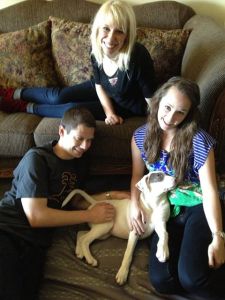
When our adult children came to town Labor Day weekend 2013—two weeks after our fifteen-year-old dog Wilson died—they despaired at our empty nest and gifted us with what they felt was the perfect “filling”—a puppy. My husband Gary was elated. I wanted to curl up into a ball and be taken to an asylum.
When Lucy was brought into the house, all I could think of—as I pasted a smile on my face and screamed with what I hoped sounded like excitement—was how much work she was going to create.
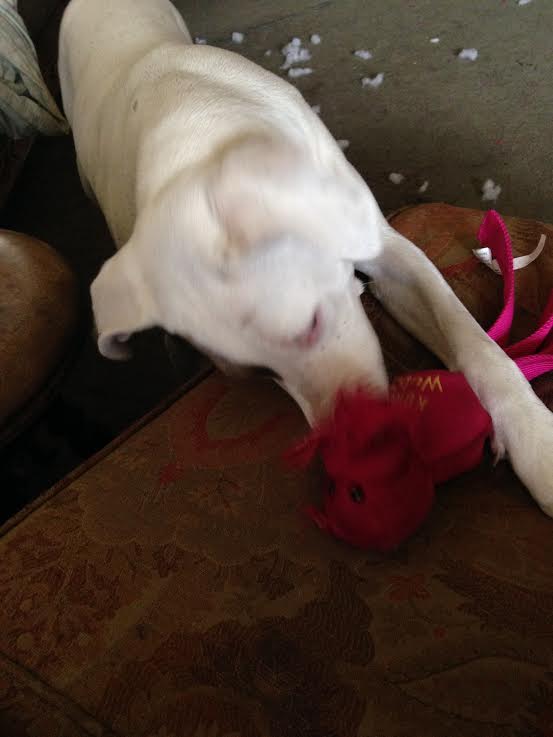 Over the course of thirty-five years, we’ve raised four puppies. Gary might have forgotten, but I knew the drill. Even with obedience training and supervision, Lucy would learn about life mainly through the destruction of property—sofa pillows, socks, underwear, plants, holes dug so deeply in the yard that a visitor asked if we’d had trees removed. Given Gary’s disabilities, the majority of transforming her into a “good” dog would fall on me.
My obsession with wanting to skip the puppy stage of her development caused me two weeks of insomnia and vertigo.
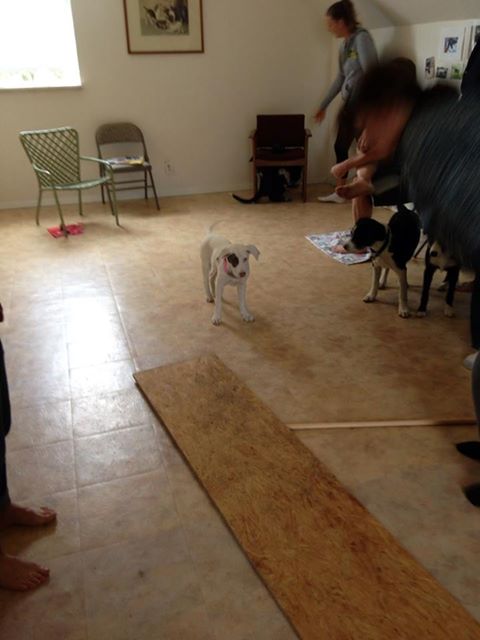 Thank God I found Puppy Kindergarten where every Saturday morning for ten weeks, Lucy had the chance to play with other puppies and sweet Elaine Miksak gave me direction on how to calm the hell down and enjoy my baby girl. For the first month, both Lucy and I returned home after class to take naps. After an hour, I’d awake to find my open mouth drooling on the pillow.
By January, Lucy had grown too large for the class (forty-five pounds), and we found Julie Apostolu, who convinced me Lucy was ready for AKC Canine Good Citizenship (CGC) training. I had no idea what that was, but hoped the eight-week course would help me continue to learn patience and understanding.
The CGC class was held in a clearing in the woods next to the Mendocino Coast Humane Society. The first day, Lucy kept tugging on the leash and gagging. She thought she was at a new Puppy Kindergarten and wanted to be free to play with other dogs. When that didn’t happen, she discovered the pine needles covering the ground hid buried cat poop that could be rooted out while pretending she was deaf to the command, “Leave it!” (She waited to come home to vomit on the carpet.)
The first few weeks of class were brutal. Lucy would not listen, jerked at her leash, and when she got tired, rolled onto her back and refused to move. Julie offered encouragement and direction, but I felt inept and humiliated.

After a particularly rigorous digging session in the yard.
One afternoon, as Lucy headed off for the fiftieth time in one direction while I tried to coax her into another, Julie’s assistant, DeeDee, came to my rescue and took the leash. Her expert handling and swift corrections got Lucy’s attention. I watched in awe as my dog looked at her and obeyed commands. Tears filling my eyes, I wanted to get into my car and drive away.
Eight weeks after we started CGC training—Lucy was nine months old—came the test. The dogs had to do things like heel (yeah, right), sit and stay (maybe), down (Lucy liked to lie down because it put her closer to the cat poop), and remain calm when left with a stranger (this would be easy—she loves everyone). All of this had to happen without benefit of treat reinforcement.
We were doomed.
My anxiety grew as I watched others go through the course while Lucy jerked on her leash and gagged. While we were on deck, she calmed down to watch the dog being tested. I looked at her sitting with such dignity and my heart surged with love. I crouched and hugged her, petting her neck and chest, and whispered, “I don’t care if we pass. I love you and am so proud of you. Let’s have fun with this.”
Lucy rose to the occasion, messing up on only a couple of things. At the end of the course, I had to hide behind a crop of redwoods while she stayed with a stranger for a couple of minutes. When I was called back, Julie held out her hand—“Congratulations, she passed.”
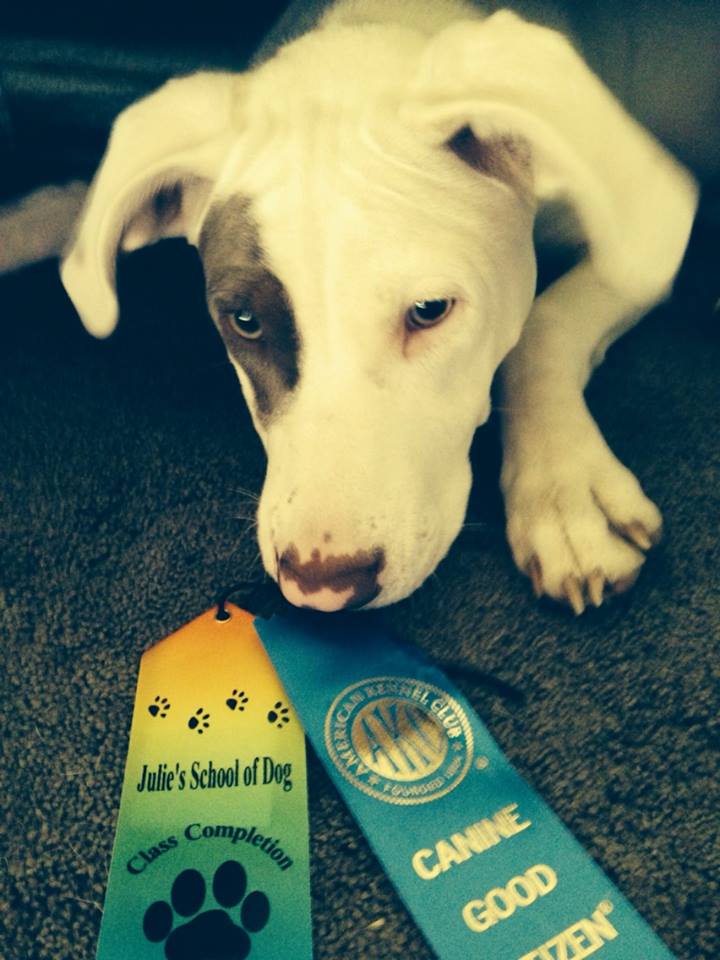
Shortly after the photo was snapped, she tried to eat her ribbons.
“What? Really?” I grabbed Julie in a hug and howled with laughter.
I looked at Lucy who sat wearing her calm snowy fur like a halo. “Good girl! Good, good girl!”
I wish I could say from that moment on, Lucy sprang from puppyhood to maturity, but no. She’s a work in progress, a spirit we enjoy despite or maybe because of her quirks (pretending she’s deaf to commands, the ability to destroy any toy in less than twenty-four hours, and a need to prune fuchsia bushes).
Since CGC, we’ve taken at least 30 weeks of other classes (Rally Obedience, Jumps and Tunnels, Nose Work) where we learn, have fun, and meet wonderful people and dogs.
I’m happy that our empty nest has been filled with fresh, rambunctious life and grateful to our children who filled a need we didn’t know we had.
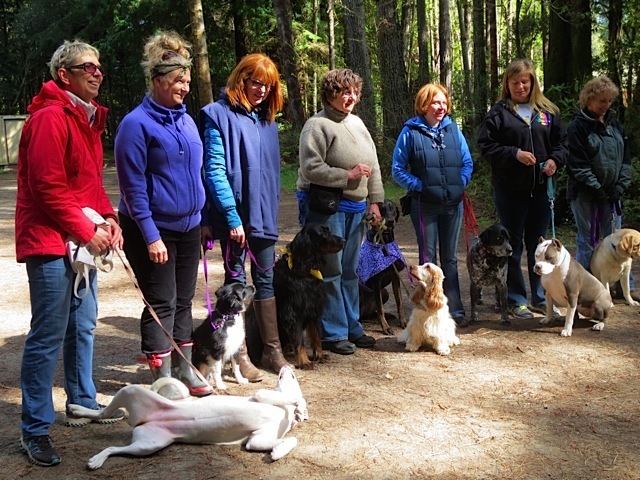
Rally O class picture. After hundreds of dollars spent on enrichment classes, this is how Lucy interprets the command “Sit!”

 If you’ve never had a colonoscopy, you may not understand why the term torture is associated with it. This applies to the day before. The patient is allowed to ingest only clear liquids, which by mid-morning sets off a primal alarm in the brain—the process of starving to death has begun. By mid-afternoon the brain partially shuts down and the patient wanders zombie-like through the rest of the day. She occasionally snaps into reality and tries to keep the whining under control by reviewing all the things she should be (but truly isn’t at that moment) grateful for: family, friends, shelter, blah-blah-blah, and good health insurance.
 After a fitful sleep, the following morning begins at four o’clock with another round of the cocktail. Kate wants to cry, but remembers there are a bunch of people in the world suffering a great deal more than her. She tries once again to concoct a gratitude list, but cannot think of a single thing.
 “Why of course I know
 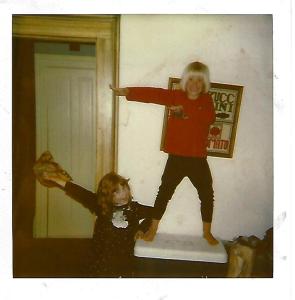 Regular play dates ensued, alternating between the Turner house and ours. It didn’t take Packie long to abandoned them for the rough and tumble company of boys.
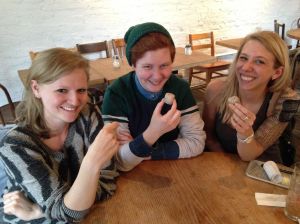 In the fall of 2008, Bryna left Fort Bragg to attend Mount Holyoke in western Massachusetts where she earned a BA in Theater. She went on to obtain an MFA from Rutgers in New Jersey. At the tender age of (almost) 27, she’s written six plays. She lives in Brooklyn where Laine and I met her and their long-time friend Britt Calder for lunch. Afterward, we walked around the area, Bryna and Britt touring us through a neighborhood where mature trees break up the concrete landscape. Raised among the Northern California redwoods, they have a special appreciation for trees.
 We parted with hugs, disappointed we wouldn’t see Bryna at the play that evening. In the first few weeks of the run, she’d hide in the back of the theater, near the light board, and spy on the audience. It was nerve-wracking to anticipate their reaction. Would they laugh at the right moments? Were they paying attention or were some reading their programs? Overall, the response was positive. Still, she found it stressful to watch her work being performed. She’d wait for the closing show to see it again.
 At the end of the performance, Laine and I stayed in our seats for a few minutes, overcome by the brilliance we had witnessed. “My friend wrote this,” Laine said, her eyes filling with tears. “I’m so in awe of her.”
















 It Happened at Purity