Maureen Leahy Koller—the bookstore & vinyl café

maureen3As a teenager, Maureen was beset by restlessness. She wanted to get out of Fort Bragg, experience the world, and seek adventure. After graduating from high school, she seized the opportunity to go to Venezuela. The problem was that this ticket out of town meant becoming an exchange student—a uniform-wearing Catholic school student.

“It wasn’t the freedom I expected,” she said. “I lived in Valencia, a dangerous city, and couldn’t go anywhere unchaperoned.” (I imagine schoolgirls in two straight lines, ala “Madeline,” under the watchful eyes of a nun as they walk from place to place.)

After that lackluster adventure, she returned to California in 1997, and attended Mills College in Oakland. This wasn’t enough to satisfy her restlessness. “My boyfriend and I wrote the names of cities on scraps of paper and put them in a hat. We pulled out Madison, Wisconsin. At the end of the school year, we packed up and moved.”

In Madison, she started what would become a career in book selling. “I worked for Canterbury Books, a sweet little independent.” After a year, she and the boyfriend split and she “decided to get in my car and drive around the country until I found somewhere to live.” She landed in North Hampton, Massachusetts, taking another bookstore job. “It felt like home. I loved the beauty of the East Coast and all of the culture Northampton manages to smash into one little town. After a while it felt too far away from home and family.”

maureen1In 2002, Maureen moved to the Bay Area where she worked in bookstores in Berkeley. At Half Price Books she meet fellow co-worker Tony Koller, who would eventually become her husband. They enjoyed living in Oakland for nearly a decade. During this time, she returned to Mills and finished a degree in English Literature.

Her love of the Berkeley/Oakland area shifted when she became pregnant. “I could deal with the high crime rate—the muggings and burglaries—but I couldn’t stand the thought of bringing up a child in that environment.” She was drawn back to her place of birth, to the hub of family.

Like Tom and Karl of Re-Find, Maureen and Tony didn’t have a plan for what they would do once they landed in Fort Bragg.

Maureen6Shortly after baby Carolyn was born in late 2010, they learned that Jennifer Wolfman, the owner of a used bookstore on Redwood Avenue, wanted to retire. “She had liquidated inventory, and by the time we bought it, there wasn’t much left. We scouted estate and library sales to build it back up.”

Six months later, they relocated the store to Franklin Street. In May 2016, they moved to their current location on Laurel. “Fifteen volunteers helped us on a Sunday and we were open for business on Monday.”

Tony works for Thanksgiving Coffee during the day, but enjoys late afternoons and Saturdays at the store. “It’s his passion,” Maureen said. “He loves being surrounded by books and touching everything. It’s his time to relax and ‘play.’ He also likes cleaning, which is good because I’m a slob.”

maureen4

Mom, Patty Leahy Carvet, enjoys reading by the sunlit window.

Maureen doesn’t have any employees, but allows selected people to work in exchange for store credit. “After Margot was born [eight months ago], my mother started mysteriously showing up every day. She works on Sundays so Tony and I can have a family day.”

Maureen has been a voracious reader all her life, reading two to three books a week. Owning the bookstore is a perfect fit. “I tend to be autocratic, and like not having to answer to a boss. I can control what comes in and what goes out. There’s a certain amount of pride that comes with owning a store—it reflects who I am.”

Now that she has two children, she doesn’t have time to scout estate and library sales for inventory and must depend upon what people bring to her. “I’m very picky about the condition of what I buy. I feel bad whenever I have to tell someone I won’t take their books because of poor condition or a musty smell. I try to stock the store with the best that can fit into the space I have.”

After Maureen says this, I notice a lack of basement storage room odor that I associate with used bookstores. The aroma of freshly-brewed coffee entices people to pour a cup and browse the store.

maureen5Some of her inventory is new, like North Coast guide books and children’s books. She makes special orders for people who don’t have internet access. Her clientele is mostly tourists, many of whom visit year after year. However, a handful of locals visit the store often.

“I came back to Fort Bragg because I no longer cared about living a glamorous life. I didn’t want to raise my kids in a big city. We could buy a house here—something we couldn’t do in Oakland—and be near family.” A bonus was being able to buy the bookstore and make a go of it. “At the time, Kindle was growing in popularity. Because of this, I thought the store would fail after two or three years. But I’ve never experienced a decline in sales—things just keep getting better.”

Maureen’s youthful restlessness is reminiscent of Dorothy in The Wizard of Oz. She left this small town and had her adventures. Substitute the ruby slippers with a new baby, supportive family and a slower pace of life, and you’ll understand how she came to realize “There’s no place like home.”Maureen7

Soul Mate

I guide my grocery cart away from the checkout stand at The Purity. I greet a friend standing at the onion bins. A middle aged woman with dark auburn hair, stylish makeup and a Guatemalan shoulder bag enters the store and collects a cart.

As she passes, she gives me a shining smile and direct eye contact. I smile back, thinking I might know her, but realize I do not. She takes a few steps toward the first aisle before whipping a U-turn and nearly colliding her cart with mine.

She’s excited, like a racehorse anxious to be released from the starting gate. I suspect something interesting is about to happen.

“We were meant to meet,” she says in a conspiratorial tone, her face beaming.

“Really?” I say.

“Yes.” She’s nearly breathless. “I saw you walking your dog yesterday. Then today, my husband drove me to the store and we pulled up next to a car and I saw your dog and I said to him, ‘There’s that woman’s dog! She must be in the store!’ And here you are!”

“Wow.” I feel like a celebrity.

celestine_prophecy_B_ARTWORK.qxd:Layout 1She leans in closer, a little too close. “Have you ever read The Celestine Prophecy?”

I’ve read a lot of stuff over the years. I search my memory banks. “No.”

“It says that if two people continue to encounter one another, they either share a past life or have something in this life they are destined to learn from each other.”

“Wow.”

“Don’t you see? I saw you yesterday and then again today. We were meant to meet.”

No one has ever been so excited to see me. “May I ask your name?”

“Lauren Conroy [not her real name]. I live on the corner of Lincoln and Whipple [not her real address].”

I hold out my hand. “Nice to meet you.”

She shakes my hand. “And what’s your name?”

“Kate.” I deliberately skip my last name and Google Map location.

She looks astonished. “Kate is the name I give when I make orders to go! You know like when you place a sandwich order at a deli counter?”

I nod.

“I give the name Kate!” Her dark brown eyes glisten.

As farfetched as I find this encounter, the fake name for take-out orders doesn’t faze me. For years, my Starbucks name has been Hazel. I receive many compliments on it.

“It’s so nice to meet you, Lauren. Thank you for stopping to introduce yourself.” I walk away, but not before noticing her expression drop into disappointment.

“Hopefully we’ll see each other again,” she calls after me.
I assume she’s a recent transplant. We live in a small town. She hasn’t learned that the chances of repeated people sightings are approximately 99.9%.

Lucy and I will have to start wearing hats and dark glasses on our daily walks.

Despite the potential danger of being stalked, Lucy cannot be talked into wearing a hat and sunglasses.

Katie Turner Carr

katie2I sit next to Katie and pepper her with questions, marveling at how the shy girl I met 23 years ago has blossomed into a self-assured wife, mother and businesswoman. When she left Fort Bragg in 1998 to attend UC Santa Cruz, she never imagined she’d return eight years later to become a sock maven.

It was probably inevitable that Katie became an entrepreneur. During her early years, her father Dave Turner owned a waterbed business in the Bay Area. When these beds waned in popularity and the internet became more consumer-friendly, he began selling waterbed accessories online. He also designed and began to manufacture a layered latex mattress system called a FloBed. Both enterprises allowed him to work anywhere. He fondly remembered growing up in Fort Bragg and wanted to give his four children the same opportunity. In 1992, he moved the family to the area.

Katie’s dream was to be an artist. After graduating from college in 2002, she stayed in Santa Cruz, sold her paintings through local crafts fairs, and made rent money by working at the Sock and Shoe Company. In 2004, her then boyfriend Marshall Carr got a job with Enterprise Rental Car. They moved to Morgan Hill. She worked briefly as a merchandizer for Lowes. “I was miserable. It’s the only job I ever quit.”

She was hired as a manager for Socks Galore in Gilroy. A few months later, the Sock and Shoe Company wooed her back and trained her as a buyer.

Katie3

Katie in her original tiny shop.

By 2006, Katie and Marshall decided their future was limited by the high cost of living in the Santa Cruz area. They hatched a brilliant idea—move to Fort Bragg and open a sock shop. She consulted her dad, who wasn’t convinced it could be successful. He asked her to write a detailed business plan that included statistics on the number of tourists visiting the area and how much merchandise she’d have to sell in order to make a living. After reviewing the plan, he rented her a 200 square-foot space at the front of his FloBeds store on Redwood Avenue.

Katie brainstormed names—Sockadeedoda, Sockadelic—before choosing to honor a favorite childhood storybook character—Pippi Longstockings. The tiny shop was off the beaten tourist path, but located across the street from the dance studio. While mothers waited for their children, they’d wander in to buy socks. “It was my busiest time of the day and helped me develop a local following.”

Katie also garnered attention among street people who were enamored with her tiny shop. She fondly remembers a man named Chris who’d stop by frequently, always beginning his visits with “Hey Pippi!” She hasn’t seen him in years, but this nickname is still used by some of her customers.

Katie6When a storefront on Laurel Street became available in June 2008, Katie moved Pippi’s, quadrupling her space and expanding her customer base. She was able to hire employees, which eased her workload and allowed her and now husband Marshall (a high school teacher) to start a family. They have two daughters—Rowan (seven) and Zoey (four).

“I’m so happy to be able to give my kids what I had—the freedom of a childhood in a small town. I want them to be able to play in the woods, on the beach or walk around downtown like I was able to, instead of hanging out in a mall.”

katie7

Sweet Rachel & her great boss.

Katie has two employees. This author is especially fond of Rachel who is kind and patient. Whenever I’m in the shop babbling about something, she’ll smile and say in a soothing tone, “I understand.” She would make a great hostage negotiator or crazy person whisperer.

One of Katie’s favorite things about owning her business is the tourists who get excited to find a sock shop. “They literally squeal with delight.” Returning customers often show her the “Pippi’s socks” they’re wearing and ask to see the socks she has on.

Katie is grateful to live in a small town that has a big community feeling.  “I’m lucky to be a part of a place where one person can make a difference, where the opportunity to participate is just about everywhere. I love knowing my barista, the person who makes my lunch, and the people I support when I shop downtown. I also love that my customers know my family.”

When her dad Dave (the mayor) was the subject of a nasty recall effort last year, Katie wrote a heartfelt blog post defending him which sparked a movement in support of him.

Shortly after the demise of the recall, she joined forces with others to organize Go Fort Bragg, which encourages progressive involvement in the community. “Before this, I didn’t pay much attention to how the city was run. I voted for council members who shared my views and let them do their jobs. I’ve learned that these people aren’t mind readers. They need to hear the opinions of their constituents. I avoid anger and express my thoughts in positive ways. This gives them and others a chance to hear a point of view they may not have considered.”

Katie & her wonderful family.

Katie & her wonderful family.

Katie acknowledges that Fort Bragg has changed since her youth. There was the music store, the old recreation center pool where she was a lifeguard, a tree at Bainbridge Park that was fun to climb. The tree is gone and many businesses have closed. “I can still hang out at Headlands Coffee House, but don’t sit on the sidewalk as much anymore.” She says this with a wink. “The mill is gone, tourism is a more integral part of our economy, but we still have the beach, the woods, and a great community that watches out for one another. We have the CV Starr Center, the coastal trails, and the Noyo Center. A lot of positive changes have enriched our lives.”

Another positive change is Katie’s return. She’s brightened our town with her optimistic attitude and charming sock shop.Katie5

Hilary White

understuff3Hilary White is one of a handful of thirty-somethings who have returned to their hometown of Fort Bragg to run small businesses. Over the next few months, I hope to interview each of them and find out what motivated their return.

I met Hilary years ago when my daughter Laine was in high school and frequented her clothing consignment store, If the Shoe Fits. I was impressed by her gentle kindness and aura of professionalism. A few weeks ago, we sat down for a chat.

Hilary believes people deserve to feel good and surrounded by beauty. “These things bring value to our lives.” This belief lured her back to her hometown and keeps her here. It is also the basis of her business and the goal of her community advocacy. She and three other downtown business owners started the group Go Fort Bragg, which promotes progressive involvement in our town. “When people participate in their communities, it adds value to their lives.”

Go Fort Bragg encourages people with diverse opinions to attend city council meetings. Hilary claims that large audiences give council members opportunities to listen to citizens. She believes one of the values of democracy is that it allows people to express themselves and to hear differing opinions.

When asked to confirm or deny the rumor that she will run for Fort Bragg City Council in the next election, Hilary answered “No.”

“You won’t confirm or deny?”

“No, definitely not.”

“So you’re leaving it open to speculation.”

She laughed. “I will not run for city council in the next election.”

***

After graduating from Colorado College in 2002, Hilary came home to work for a few months at Out of This World in Mendocino. Her plan was to move to New York (where she would rent a room from friends and figure out what to do with her life).

understuff5As fate would have it, she developed the hots for coworker Martin Nakatani. A romance blossomed and she abandoned her New York plans. They eventually married and settled in Fort Bragg.

Like many people along the Mendocino Coast, Hilary had to hold two or three jobs in order to make ends meet. In 2004, she began working at If the Shoe Fits. A mere three years later, she bought the business.

understuff1In 2012, she bought Understuff, an intimate apparel boutique. I wondered what prompted her to make a career in under garments. (Her answer wasn’t nearly as titillating as I’d hoped.) The owner of the store wanted to retire and encouraged Hilary to buy it. Hilary knew it was a viable business and didn’t want to see it close. After a few months, she sold If the Shoe Fits to Fort Bragg native Kerry Hagan and bought Understuff.

Over the years, Hilary has experimented with her inventory to include a variety of clothing—coats, jackets, pants, swim suits and practical pajamas. After the shop moved to Main Street, it gained more tourist traffic. “That’s been fun because it allows me to stock things that might not be affordable for the local market, but are beautiful for everyone to see.”

understuff2

Hilary and her equally discreet employee Nicole.

I tried to get Hilary to share funny stories about her customers, but she declined. Because of the nature of intimate apparel, she must be discreet. I find this reassuring. My brassiere preferences are stored in her computer. I hesitate to think of the stir this would cause should that information be leaked to the public.

Hilary is grateful that owning a business allows her to live in a place she loves. She appreciates being part of a community of downtown business owners who support each other. For example, when she relocated her store, Chriss Zaida of Toto Zaida was part of her moving crew. As Chriss prepares to move her store to Main Street later this month, Hilary and Martin have pitched in to help.

understuff4

Downtown crew helps Toto Zaida prepare to move to its new digs.

As a small business owner, Hilary has learned to adapt to changing conditions and trends. She feels the same holds true for the entire Fort Bragg community. “We don’t have to despair over what we once were [a thriving logging and fishing town] but we can make new things happen, like coastal trails and marine science centers. We can evolve while continuing to respect our heritage.”

Hilary is every bit as great as everyone says. On the surface, she exhibits a grace from a gentler era, dresses with panache, and has excellent posture. I’m happy to let you know that she’s also warm, vibrant, and generous with her laughter. Our town has benefited by her return.

41 Days

At 9:30 last Saturday evening, I shut off the television and turned off lights before heading upstairs to bed. My husband Gary was already asleep. I heard a yowling outside that sounded familiar. It started at the sidewalk, gained momentum up the walkway, and came to a fevered pitch on the front porch. I looked out the door’s window and was convinced the nachos I’d eaten for dinner had been laced with peyote. Our cat Little Mister stood poised like a bullet ready for the door to open.

I yelled at Gary. “Little Mister’s home!”

“What?” he said in drowsy confusion.

Little Mister had been gone 41 days. I thought he was gone forever. Yet there he was howling at the door. I opened it and he ran halfway up the stairs before stopping. I stood, frozen, transported to an alternate universe where I was staring into the eyes of a pet that I’d given up for dead.

Water!

I ran to the kitchen, poured water into a bowl and raced upstairs. I lightly petted him as he took a few sips.

Food!

Store! Go to the store!

I wrestled a jacket over my pajamas. Wait! Marcia has a cat and it’ll take less time to get to her than to the store. I prayed she was still awake. She was, and met me outside her house with a sandwich bag full of cat food. I sped back home, filled a bowl with food and ran upstairs.

LMRECOVERY4I sat with Little Mister and petted him while he munched on the kibble. He looked at me and meowed. It was pathetic and weak. I picked him up and felt the literal interpretation of the phrase “bag of bones.” His eyes were bright, but his coat was disheveled and dull.

For weeks after he disappeared, I expected to hear his meow when I passed by the front door, to find him in the middle of my bed when I went upstairs. I missed him most at night, cuddling at my side.

I didn’t miss his 3:00am—every 3:00am—insistence upon being let outside. And I especially didn’t miss having to keep him and our dog Lucy separated because he hated her puppy energy.

LMRECOVERY3I got into bed, tried to relax and pretend everything was normal. Little Mister, as is his custom, sat on my chest, wedging himself between me and my book. For the first time in 41 days, I cried. “You poor, poor thing, I can’t imagine where you were and how you suffered. I’m so grateful you’re back.”

Weeks earlier, in the midst of the Christmas holidays, I’d resigned myself to his disappearance by thinking he’d been ill and wandered off to die. My tears were a mixture of compassion for his plight and guilt over having so easily dismissed him.

His return was a cosmic slap in the face, making me realize his is a life that matters. I took responsibility for nurturing that life when he came into our home eleven and a half years ago.

The next morning, I got up at six and Little Mister wanted to go outside. We had no litter box and I took this as a sign that he was well enough to return to his familiar routines. (I now realize that I was still in the throes of suspended reality.)

A few hours later, I called him, but he didn’t show up. I walked to the sidewalk and heard a faint meow coming from next door. I found him crouched behind a bush in the neighbor’s yard. It broke my heart to see him looking so helpless, unable to traverse the short distance home.

I picked him up and scolded myself for having let him outside. His ordeal had drained much of the life out of him. His eyes, bright at his return the night before, were dull. He ate a bit of food and I settled him on the bed.

Gary and I speculate what might have happened. On that rainy night of December 20, Little Mister must have sought shelter, perhaps in someone’s rarely used garage or shed, and got locked in. He must have had access to water and maybe some critters. His frantic yowls upon his return convinced me that after 41 days he’d gotten his first chance to escape.

LMRECOVERY2I’ve set up a litter box and will keep him inside. He’s been to the vet who discovered that he has the “reddest throat and biggest tonsils I’ve ever seen on a cat.” She gave him a little IV hydration boost, some antibiotics, and a shot of what she called “cat morphine” to ease the pain in his throat. “Cats tend to like opiates,” she said. Little Mister agrees.

I’m happy that Little Mister is back. I promise to do everything in my power to return him to his normal fatty, demanding, Lucy-hating self.

The Spirit of Giving

A few weeks ago, my friend—let’s call her Nell—said she felt guilty about throwing away donation plea letters that arrived in December. Throughout the year, she was generous to charities, but during the Christmas season her money was spent on gifts for family and friends. Still, she wished she could answer all the pleas.

She remembered a quote attributed to Jon Carroll. He allegedly said that if you want to give away money, go to the bank, take out as much cash as you can afford, and distribute it to people on the street.

5This appealed to Nell. Nearly every day, she saw homeless people and others in need. But she never paid much attention as she whizzed by in her car or, when walking, crossed the street to avoid them. She thought about her “Fiver Envelope.” Whenever she receives a five-dollar bill as change in a transaction, she saves it. After gathering a bunch, she uses them to treat herself to a massage or some other luxury. She decided to take the $100 she’d accumulated and give it away.

The prospect of approaching complete strangers scared her. She formulated a couple of rules: she would only interact with solitary people, no one in a group; and she would not interfere with those who looked mentally unbalanced.

PostOfficeShe found her first person one early cold morning at the post office. A dented maroon car stuffed with clothing pulled into a parking space, the back bumper tied with a rope on top. A weary woman with thick black curly hair struggled to get from the vehicle and up the post office steps.

Nell pulled a five from her wallet and folded it in half. When the woman entered the building, Nell asked, “May I give you something?”

The woman looked wary.

Nell held out the money.

The woman looked confused and asked, “Why?”

“Because it’s Christmas.”

The woman took the money. “That’s it? For no other reason?”

Nell said, “Yes,” and wished her a Merry Christmas.

“Thank you so much.”

Nell felt happy, very happy.

The second was a young wispy woman wrapped in layers of clothing to stave off the cold rain. She was walking with a black pit bull that wore a padded doggie jacket. Nell pulled to the curb and got out of her car. “May I give you something?”

Again a wary look.

Nell held out a five.

The woman grinned, yet looked close to tears. “I’m so glad I turned around and started walking this way. Otherwise, I wouldn’t have met you.” She gave Nell a hug.

DSC02402The next day, Nell was walking to her car in the Purity parking lot. She noticed a heavy-set woman putting her baby in a car seat in the front of a yellow dented pickup.

As Nell held out her offering, the woman backed slightly away and adjusted her glasses. “I shouldn’t take it.”

Nell reached her hand out further. “Please, I want to give it to you.”

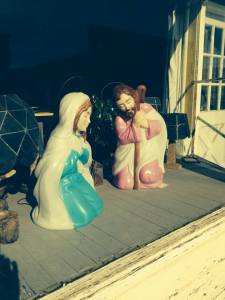
“Thank you. I really do need gas money.” She invited Nell to the live nativity scene produced by one of the local churches on Christmas Eve. She said her baby would play the role of Jesus. She blessed Nell as she walked away.

DSC02477A few days later, Nell saw a middle-aged blonde woman fishing through a public trash can. When she gave her five dollars, the woman beamed. “Thank you. It’s my birthday.”

Nell’s heart soared. “Happy birthday, my dear!”

Every time Nell gave away money, she felt immense joy. She was as grateful for the offering as the recipients were to receive. Most interactions were less than a minute, but during that time she was able to look a person in the eyes, touch his or her hand and, in a few instances, receive a hug. In those moments, she felt something she had never allowed herself to internalize—these are human beings just like her. They have feelings, fears, hopes, and dreams. Yet their daily lives are immeasurably more difficult than hers.

She felt compassion.

DSC02540Her last five was given to someone she sees frequently—a tall, lean man who sports a camo jacket and walks a dog with a matching bridle coat. He’s a loner, who appears to avoid others. It was shortly after the New Year and raining. She spotted him on the sidewalk. He was walking so fast that she pulled over a block ahead. She got out of the car with trepidation. He’d always seemed stoic and she wasn’t sure how he’d react to her approach.

“Hi,” she said.

He returned the greeting with a slight twinkle in his eyes.

“May I give you something?” She held out the folded bill.

“Are you serious?” he asked.

“Yes, please, I want to give it to you.”

He grinned. “Thank you.”

She had never been close to him. She looked at his face—really looked at it—and saw a kind man in his forties with well-sculpted features and dark brown eyes who somewhere along the line learned to keep to himself. She reached down and petted his dog, grateful that he had a companion.

“Happy New Year.” As the words left her mouth, she regretted them. They sounded hollow and trite.

“Happy New Year to you,” he said, leaving her with the gift of his smile.


DSC02521

Goodbye Little Mister

LilMrEleven and a half years ago, our son Harrison graduated from high school. That summer, he was left alone for a week while his sister, dad and I went out of town. We returned to a house wiped clean of any evidence of partying and a fluffy gray kitten to add to our menagerie of two dogs and three cats. (While we were gone, he’d encountered someone outside a restaurant with a box of kittens.)

We had more than enough cats. Harrison was, technically, the owner of one. As a child, he’d been given a short-haired, half feral kitten that he named Indiana Jones Riley. (Indiana turned out to be a girl.) He argued that Indiana was far from friendly and he’d always wanted a fluffy gray cat. We explained that he was going off to college in a couple months and we’d be stuck with it. In order to sway us, I think he finally said please or something nice. But I really don’t remember.

He named her Pancake. Laine called her Lily. I called her Harrison’s Parting Gift.

Lily was a feisty little thing that hated physical contact. In an effort to domesticate her, she was required to eat while sitting on someone’s lap and being petted. It didn’t take long before she begrudgingly relaxed. She lurked about with jaunty confidence, and tortured our two older females with surprise pounce attacks. Laine’s male cat Figaro would have none of that, whacking Lily with a paw whenever she got close. I nicknamed her Little Sister—the obnoxious baby of the pack.

When it came time for her to be spayed, the vet discovered that, under all that fluffy fur, Little Sister was actually a Little Mister.

Over the next few years, as the older cats died off, Little Mister reigned supreme. Our two large dogs gave him a wide berth whenever he strutted about the house. He was a talker and not shy about asking for what he wanted. “I need food!” “Let me in!” “Let me out!” “Pet me!” “Stop petting me!”

Two years ago, we were given a puppy and Little Mister’s dictatorship came to an end. All Lucy ever wanted was to establish a playful relationship with him. All he ever wanted was for her to go away. My efforts to integrate them failed. Relative peace was finally established by erecting a baby gate on the stairs. Little Mister spent his indoor time upstairs, safe from intolerable puppy energy.

***

On an early evening nearly four weeks ago, I put him out. He’d been sleeping all day and company was coming over. If he didn’t go out then, he’d insist upon it later and wake me in the middle of the night to get back in.

Before going to bed, I opened the front door, expecting him to rush in, scold me for leaving him out for three hours in the wet cold, and race upstairs with a chirp which translated, “I’ll never speak to you again!”

He wasn’t there. I called and called, but he didn’t show up. It wasn’t the first time he’d failed to come home. It was no longer raining. He’d probably show up howling in the middle of the night.

But he didn’t.

cat(7)It was the week of Christmas. We had a house full of people and activities. I was concerned about Little Mister, but consoled by the knowledge that he’d sometimes disappear for two to three days at a time. On our walks around the neighborhood, Lucy and I looked for him. Several times a day, I’d open the door and call his name.

As time went by, I wondered if he’d been ill. For the past few months, he slept a great deal. Unless it was three o’clock in the morning, he rarely demanded to go outside. I’d have to hunt him down in the afternoons to put him out where he’d usually spend less than an hour.

The day after Christmas, Laine suggested we check the Humane Society to see if someone found him. I agreed, but wasn’t surprised when he wasn’t there. Little Mister would never, ever let a stranger capture and transport him.

It’s an odd feeling to have a pet disappear. I’m sad, but not emotionally broken. Over the years, I’ve experienced the heart-wrenching grief of watching five dogs and three cats deteriorate to the point where they had to be taken to the vet to end their suffering. I suspect Little Mister wandered off to die, but carry the hope that he’ll return. A tad of wishful thinking allows me to fantasize that he found another home—one with a sweet little lady who doesn’t have a puppy and lets him lounge on her lap all day.

At times, I hear his chirp at the front door only to open it and find the porch empty. Whenever I go upstairs, I anticipate him nestled in the middle of the bed. I miss his insistence upon being petted as I read at night, wrestling his way onto my chest, between my face and book, purring and drooling.

I’ve finally washed his bowls, taken his remaining food to the Humane Society, and removed the baby gate from the stairs.

Four weeks ago, I watched his gray fluff scurry out the front door. If I’d known it was going to be the last time I’d see him, I would have at least said goodbye.LilM

Luck of the Draw

The recent terrorist attacks in Paris and San Bernardino leave me with face in hands, shaking my head in despair, and asking the great unanswerable question: What are we, as human beings, doing to ourselves?

JourneyOver twenty years ago, my husband Gary and I loaded the wagons and left a metropolitan area peppered with gang activity, drive-by shootings, and armed robberies. We trekked north to tiny Fort Bragg with the aim to raise our two young children in a town reminiscent of what life was like when we were growing up.

This community sheltered our tender saplings from the harsh winds of big city realities and allowed them to grow strong and tall. Along the way, we exposed them to places outside this protected island. We encouraged them to eventually leave and experience the real world.

By their senior year in high school, each was eager to squeal their tires, lay rubber, and flip off this small town. They left for college, junior years abroad, and eventually to careers in San Francisco. They have no desire to take up residency here again—even after all the terror that’s sprouted up in “civilized” cities across the world.

Our older children and grandchildren live in Seattle and Boston. I want to scoop everyone up and gather them in Fort Bragg to keep them safe from random acts of violence. But I know they won’t agree to come.

This is the world they’ve matured into and they are much more adaptable to change than I am. childmeI grew up in an era where people didn’t lock their doors—even when they went away on vacation—and often left keys in their parked cars; where children could safely walk alone without fear of abduction; where crazy people didn’t storm public places with automatic weapons and open fire. Today, none of this holds true; it is merely a quaint tale from the distant past.

Fear for my family occasionally becomes my sparring partner and I work hard to beat the crap out of it. turkey_map_02When our daughter Laine recently announced she was going to Turkey, I went to the atlas to reaffirm that the country shares a border with Syria. Fear and I went a full ten rounds. The day after her arrival in Istanbul, we woke to a headline that Turkey had shot down a Russian fighter jet for allegedly violating their air space. I spent the day punching fear in the face.

The following day, Russia stated it would not declare war on Turkey. Thank God. I needed a breather. Now that she’s “safely” back home in Oakland, those two countries can have at it. I am powerless to stop whatever madness is to come.

The chances of an encounter with a life threatening, potentially life ending event has always been the luck of the draw. Lately, though, the odds seem increasingly stacked against us. We are being given far more opportunities to draw the short end of the stick.help

Cash Flow

In the summer of 2008, after numerous citizen complaints, the Fort Bragg city council passed an ordinance against panhandling. I was relieved.

PanhandlingFlyerIn lieu of giving strangers money, I prefer to donate to organizations that help the homeless and those in need. But as the town’s panhandling situation escalated, I felt pressured. It got to the point where I couldn’t go grocery shopping or walk downtown without being asked for spare change. When I finally mustered the nerve to deny one guy, he told me to “Have a nice day, bitch!” Well there he went, ruining it for everybody. With few exceptions, spare change has stayed in my wallet from that moment on.

Some years ago, I drove around Spokane, Washington, with our son Harrison collecting what he needed to move into a dorm at Gonzaga University. On our one hundredth trip to the Valley Mall, I pulled onto the freeway off ramp and stopped at a light. A short, stout woman with hair the consistency of a bird’s nest stood in the dry weeds next to the street holding a sign that stated, “I need money to get out of here.” Perhaps it was her extreme twitchiness that prompted me to roll down my window and ask, “Where are you going?”

“Idaho.”

She was only twelve miles from the Washington-Idaho border. Her chances of success were quite high.

“And then I’m going to the state after that and then the state after that and the state after that….”

I reached into my wallet and pulled out the first bill I touched. It was a five.

“Thank you, thank you, thank you.” She shouted as she took the money.

The light turned green and I proceeded to the mall.

“You know she’s going to buy drugs with that money, don’t you?” Harrison said.

“I suppose.” I didn’t tell him I had experienced times in my life when I wanted to make a run for the border and keep going to the state after that and the state after that.

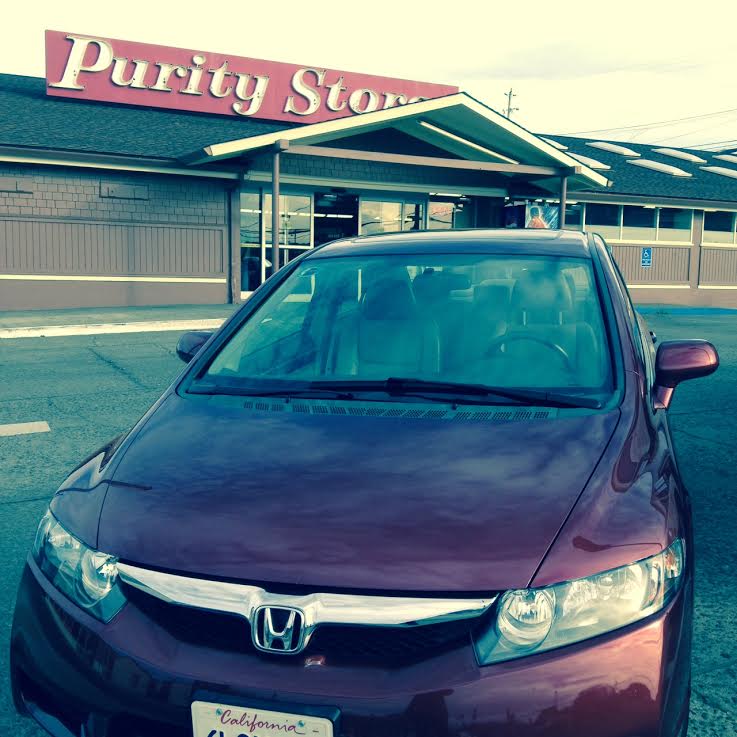
mycarThis past spring, about a month before a van tried to run me over in The Purity parking lot, I found a dollar on the sidewalk. I put it in a cup holder in my car. I would give it to the first street person who asked for money, preferably someone encountered in the parking lot at The Purity.

I was surprised how long it took to pass along that dollar. Seven months after finding it, I was downtown on Laurel, walking along the north side of the street. As I approached Pippi’s Longstockings, a young man and woman crossed the street from the alley.

Both were tall and lean, the kind of lean that borders on emaciated. Despite the warm weather, they wore sweatshirts, the hoods pulled over their heads and down to their eyebrows. His was gray, hers a faded red. There was a dark desperation about them, the kind of look I get when I’m denied my mid-morning sugar fix. I gave them a nod of acknowledgement, a smile of understanding. I’ve been caught without cookies in the house when I dearly need them.

As if I’d tossed a lasso and pulled her in, the woman approached. “Do you have a dollar?” she asked.

I do.” It’s difficult to describe the joy that came over me. Someone had finally answered my call and I was able to relinquish the responsibility of being a good steward of found cash.

The original Purity dollar was in my car, but I had a substitute in my wallet. I pulled it out and handed it to her along with a big smile. She snatched it from my hand. “Thank God,” she said, with a deep sigh of relief. It was the same relief I feel when, hopeless, I remember a stash of mini-muffins in the freezer.

Her man friend had continued north through the alley. She quickened her stride to catch up.

Perhaps she’d use that dollar to feed her addiction. Maybe it would help her buy some food. Possibly it would help get her to the next state, and the state after that, and the state after that.