Grey Whale Inn Haunted Tour

gwinnThis past Friday, my son Harrison, daughter-in-law Kasi and I went on the Grey Whale Inn Haunted Tour. The inn was built in 1915 as the town’s hospital, retains some of the old time hospital ambiance—wide doorways to accommodate gurneys and steep ramps where staircases might otherwise be—and is rumored to have ghostly visitors.

At the suggestion of daughter Jenn (who lives in the Seattle area), I downloaded an app called Ghost Radar on my phone.

gwinn2Our guide Marnie was delightful, dressed in Victorian garb with her hair pulled up in the fashion of the era. She had not heard of Ghost Radar but was happy to let me run it during the visit.

I’m not going to reveal any spoilers—you need to take the tour yourself and learn about the history of this remarkable building—but I will share a bit of our experience.

About a half hour in, while on the second floor, a young blonde boy appeared from around a corner. It was a scene straight out of “The Shining.” He looked about eight years old, and stood stick straight and mute. Marnie smiled, and asked, “Would you like to join us?”

He said, “Yes, but I need to ask my mom,” and disappeared behind the corner.

A few minutes later, the boy, his mother and slightly older sister caught up with us. Marnie cautioned that if anyone became scared and wanted to leave, they could. As we walked along the hallway, the boy stuck his index fingers in his ears and intermittently squeezed his eyes shut. His mother chuckled. His sister rolled her eyes. Marnie asked if he wanted to leave the tour. Fingers still in ears, he shook his head.

Ten minutes later, he’d had enough. His mom allowed her daughter to stay with us and escorted the boy away. Marnie asked the girl her name.

“Hazel,” she said.

“Hazel!” I said. “Whenever I’m asked my name at Starbucks, I say Hazel.” The girl humored me with a giggle.

The tour continued for several minutes before the boy and his mother reappeared. As frightened as he was, he couldn’t seem to help himself—stories of the inn drew him back. He remained until the end and smiled with relief. We congratulated him on being so brave.

Ghost Radar picked up a number of spirits sprinkled throughout the building, making the experience both satisfying and creepy.

Grey Whale Inn Haunted Tours are available through Halloween: Thursday-Saturday 12:00, 2:00, 4:00 and 6:00pm; Sundays 1:00 and 3:00 and 5:00pm. To reserve a spot, send an email to stay@greywhaleinn.com or call 707-964-0640.

I promise you’ll enjoy it.gwinn6

Sheila Struckmeyer

sheila5Sheila was raised on an organic farm in Fort Bragg and learned to make soaps, facial scrubs, and lip balms. She never imagined this knowledge would allow her to earn a living. As so often happens in life, one thing led to another and here she is—the owner of Bella Mia, a petite treasure tucked into the back room of Understuff on Main Street.

***

Born in 1976, Sheila grew up with a large extended family on the same property where her mother was raised. In addition to farming, her dad was a woodworker. “My family was self-sufficient. The attitude was if you want to do something, just do it. There were few limitations.”

Her mother had a passion for growing the unusual—like kohlrabi and currants. “In the early eighties these were novelties. Margaret Fox and Chris Kump (then owners of Café Beaujolais) were on the culinary edge and used uncommon ingredients in their dishes. Whenever I’d go on a delivery with my mom, Margaret would feed us something yummy.”

sheila7

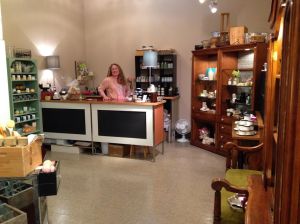
The effervescent Sheila welcomes visitors to her beautiful store.

Sheila’s formal education was a mixture of private, public and home schooling. “For a while I went to a Hippie school where no outdoor shoes were allowed inside. We had to change into Chinese slippers, and call teachers by their first names.” As a teenager in the early nineties, she wanted to go to “normal” school and wear designer jeans. She went to Mendocino High for a year before enrolling herself in Fort Bragg High. “They asked, ‘Where are your parents?’ I said, ‘Why do they need to be here?’” She laughs. “I was taught to take charge of things on my own. I never asked them to come with me.”

After graduating from high school at age 16, Sheila drove to Washington State with a boyfriend and lived in Friday Harbor on San Juan Island.

Sixteen?

She laughs. “My parents felt if that’s what I wanted, I should do it.”

After a year, the boyfriend and island living lost their appeal. She drove back to Fort Bragg.

Alone? At seventeen? Before cell phones?

Sheila employs a local soap maker to create these fabulous bars.

She laughs. “I never felt unsafe. There were plenty of rest stops along Interstate 5 that were clean and well-lit at night. When I got tired, I’d pull into one and sleep in my car. At each stop, there was a group of women volunteers—I think they were nuns— who handed out cookies.”

After a year of waitressing, she worked for the Village Toy Store in Mendocino. “The owners, Bill and Susie Carr, changed my life. They encouraged me to have a career, taught me bookkeeping, and how to run a business. I started saving for retirement at the age of 18. I consider them family and we remain close.”

The toy store job sparked a love of working retail. After the Carr’s sold their business, Sheila worked for a number of stores. A job at Sallie Mac nudged her to open her own business. “She carried an exclusive line of skin care products from a French company that required all sales people to go through extensive training in order to present them properly. I learned a lot about how these are made and why certain ingredients are chosen.”

Sheila combined her knowledge of organic skin care products with that of aromatherapist friend Melanie Knox and made gifts for friends and family. They eventually expanded their operation to sell at craft fairs.

“Our first craft fair was the opening day of the 2008 Whale Festival—the one that had the worst weather ever on that Saturday morning. There was thunder, lightning, hail, and torrential rain. We set up in the Company Store and I worried we wouldn’t sell a thing. But we sold out in five hours and made $1,000. We were so excited.”

sheilaWhile traveling the craft fair circuit and working for her mother (who owned a nursery), Sheila contemplated opening a store. Her husband Michael wasn’t sure it could be successful. They’ve been married 10 years and come from very different backgrounds. “I have a sense of no limitations while he’s more conservative.”

They met at the Tip Top one night when she was the sober driver for a young friend’s twenty-first birthday. He lived in Sacramento, but his family had a house on the coast that he’d been visiting most of his life. “We dated for a year. On the Friday after Thanksgiving, exactly a year after we met, he proposed to me in the place we had our first kiss—his parents’ house on Todd’s Point.” He moved to Fort Bragg and works for North Coast Plumbing.

Drawing on the can-do spirit in which she was raised, Sheila spotted a “For Rent” sign on Laurel Street in 2012 and 15 days later opened Bella Mia.

In 2013 her mom was diagnosed with ALS and died two years later. Helping her mom through her illness and mourning her death took a tremendous emotional toll on Sheila. “Creativity and grieving don’t go hand in hand. I felt like I couldn’t make anything or go to my shop and make chit chat. I had lost my mom, so what else mattered? My lease was coming up in April of this year. I wanted to close the store. Hilary [White] had lost her father six months before my mom died and knew how I felt, but was concerned that I’d regret that decision. She had an empty room in the back of Understuff and convinced me to move in. I’m so grateful to her.”

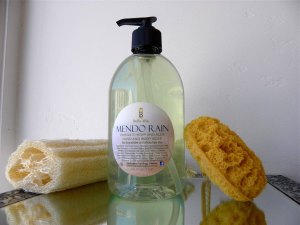
sheila2Like other business owners, Sheila works long hours, but enjoys being her own boss. “If I decide to do something, I do it. I don’t have to discuss it with anybody.” She makes her products daily. My personal favorite is her Mendo Rain soap. Imagine standing on the Mendocino Headlands on a crisp, clear morning after a storm. Take a deep breath. Sheila has captured this pure, clean aroma in her liquid soap. (If you live out of the area and can’t get to the headlands, order it and you’ll see what I mean.)

“I like the creative process of making things. I can be focused and completely present in the task—Zen.” This Zen quality is manifested in her store—it feels harmonious and, even though well stocked, has a minimalist feeling, allowing for a relaxed shopping experience. She’s proud that most of her customers are locals.

Sheila hopes someday Fort Bragg’s economy returns to a balance between business and tourism—where businesses are created to help young people stay here. In the meantime, she continues to do what she can to add to the economy while generously sharing her joyful spirit.sheila3

The Reluctant Spartan – Part II

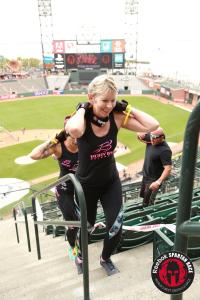
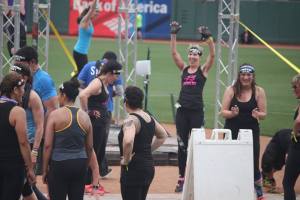
spartan5It was a cool gray morning at Giants Stadium by the Bay. I shivered not from the cold, but from utter terror as I watched Spartan participants run up to the very top deck of seats. I’m terrified of heights to the point where I start to hyperventilate. I could not do this. What was I doing here?

My brain ping-ponged for a solution. I stood behind my teammates, hiding my anxiety. Yvette had the logo “Bald Hill Cattle Company” printed on the back of her shirt. I did something I rarely do—asked for help. She agreed to stay directly in front of me while we traversed the stairs. I would focus on that logo, not on the vast distance between the elevation, the playing field, and the endless stretch of water beyond.

In that moment, I surrendered. I accepted that it was okay to be the laggard of the pack. Others could take the lead. I was content to follow.

spartan2It was time for Team Mendo to queue up. Bethany (who had finished her competitive race in under 40 minutes) announced she would run the course again with us. She had been the key force behind getting us to this place. She was going to see us through to the end. We walked around a corner to encounter our first obstacle—a four-foot fence to scale before we got in line.

I chuckled. Here we go.

Participants were released every minute or so in sets of 20. As each set waited, an emcee got the group jacked up by yelling, “WHO ARE YOU?” to which the group responded, “WE ARE SPARTANS!” My mind whispered, “I’m a scared little wieny.”

We were off and running down the lower deck of stadium stairs, into the basement to the Giants’ locker room where we were to perform 20 pushups. Halfway through my set I noticed the room smelled like years of embedded sweat. I found it funny that this place belonging to a major league baseball team smelled like any high school boys’ locker room.

The obstacles blur in my memory, but a few stand out. The first wall we encountered was eight feet tall. As I contemplated failure, Bethany rushed up and hunkered down with her fingers laced. “Put your foot in here,” she commanded. She boosted me up and I lurched over. Some obstacles later, we repeated the same move. Near the end was a six-foot wall. I turned to Bethany, like a child to her mother, and said, “Help me.” She said, “You can do it.” And by God I did—with a running leap I was up and over.

It was thrilling to accomplish obstacles I didn’t think I could do—like pick up a 50-pound concrete cylinder, carry it 20 feet, put it down, do five burpees, pick it up, carry it back, and do five more burpees. A shot of adrenaline propelled me onward where I got another shot and another until I was halfway through the race, shouting, “This is fun!” and meaning it.

My fear of heights was put to the test early. I kept my focus on Yvette’s “Bald Hill Cattle Company” logo and used a hand as a blinder to block out the scenery far below. Up to the top deck of seats and over, down and over, up and over again, I refused to let my gaze waiver, concentrating only on taking the next step. I nearly cried with relief when it was over.

spartanraceAbout ten obstacles later, we were told to pick up a 20-pound beanbag and go out to the stands. I’ll be damned if on the other side of the stadium—the side I hadn’t seen earlier—we didn’t have to repeat a mirror trek to the upper deck. By then I was a full on adrenaline junkie. I’d done it before, I could do it again. This time I didn’t have to rely on “Bald Hill Cattle Company.” Instead, it was “Hell yeah, bitch—I got this!”

Spartan rules dictate that when you fail an obstacle you must do 30 burpees. I only missed two—the rope climb and the spear throw. I didn’t even attempt the rope climb—in training for it, I’d hurt my back. I missed the spear throw by an inch.

The last obstacle was the monkey bars. I’d tried it a couple of times in training, barely able to hold myself stationary for more than a few seconds before feeling my arms were going to rip from my shoulder sockets. I headed toward the burpee area when Yvette said, “I’ll help you.” I jumped up and grabbed the first bar. She clutched my legs and literally carried me across. Between her and Bethany, our other two team mates also got across.

spartan8When it was Yvette’s turn, Bethany tried to assist. A Spartan monitor appeared, yelling, “You can’t help her.” Bethany said we were a team and we’d been helping each other all the way. He barked, “You can’t help her on this one.” Bethany countered, “We just helped three of our teammates with this one.” He stood firm.

In retrospect, we should have jumped him and beat the crap out of him. Instead, we watched as poor Yvette struggled halfway through before dropping. Disappointed, she prepared to do her burpees. The team told her to stand aside—we’d each do eight for her.

spartan7I rose from my final burpee and looked into the stands to find my son Harrison, daughter Laine, and her boyfriend Jeff smiling at me. (My husband Gary and daughter-in-law Kasi couldn’t be there.) I raised my arms and jumped up and down. It was one of the happiest moments of my life.

Our team ran through a series of punching bags to the finish line. We linked arms and crossed together. On the other side, our necks were draped with a ribbon holding the heaviest medal we’d ever received. We laughed and hugged and posed for pictures.

We are now part of that crazy cult called Spartans.spartan3

The Reluctant Spartan – Part I

I’ve never considered myself a competitive person—unless you count growing up with four siblings and competing for the attention of my overwhelmed parents. During my first five decades on the planet, I also never considered myself an athlete or remotely fond of physical activity.

earth dayOn Earth Day 1971, I was a junior in high school. My sister (a sophomore) and I decided to honor the day by walking instead of driving the five miles to school. We stopped for three cigarette breaks and once to smoke a joint. At the end of the day, we walked eight blocks, decided the trek home would be too arduous, and stuck out our thumbs to hitch a ride. Our Spanish teacher picked us up and gave a lecture on the dangers of hitchhiking until he deposited us on the curb outside our house. We crept to the backyard to enjoy a smoke before going inside.

I smoked off and on for the next 30 years, entertaining myself during the off years with Dance Aerobics in the eighties and walking my dogs in the nineties. At the age of 50, my teenage son needed me to sign consent for him to join a gym. Before I knew it, I’d also signed up. I’ll admit I fell for the sales pitch of the family discount, but also hoped that exercise classes might help shed the 15 pounds menopause had piled on and make me feel less like a sausage packed into my clothing.

photo(1)My friend Kathleen and I took classes, worked out on our own, and eventually, with a personal trainer. We grew stronger and, I dare say, a little cocky. Six years into this regimen, she suggested we do a triathlon. I agreed before I fully knew what it meant (or how to spell it)—a half-mile swim, 22-mile bike ride, and 5k run. We worked out six days a week, and created a motto: To finish is to win.

We finished.

This race taught me: (1) I’m more physically capable than I think I am; and (2) I will never do it again (the open water swim was terrifying). But the experience was a tipping point—it made me yearn to challenge my body and expand my capabilities.

I started entering local 5k races. The year I turned 60, I won first place in my age category in two races—not because I’m fast, but because I was either the only woman in that category or the few others were a lot older. The year I turned 61, I ran five races, motivated by the fact that my friend Sandy would turn 60 the next year and she’s much faster than I am. That would be my last year to collect ribbons and medals. (I got four.)

spartan1This past January, a group of fellow gym rats—Beth, Yvette, and Jan—invited me to join their Spartan team for the May race at AT&T Park. My personal trainer Bethany had done a number of these and always came back battered and bruised, but high on accomplishment. I watched a YouTube video and told the group, “What kind of crazy would do such a thing? I’m 62 years old for God’s sake. I work out four times a week and run 5k races. Leave me alone.”

They kept me on their email thread. A few weeks later, I asked Bethany if she thought, with proper training, I was capable of the challenge. “You could do it today,” she said.

I signed up.

Fear of failure and letting my teammates down became major motivators. I was two, eight, and thirteen years older than the other three members of my group. I pushed myself—strength training and running six times a week. I won’t lie, training wasn’t easy. For example, I’d never run more than 3.10 miles (5k) in my life. Each quarter mile beyond that was exhausting, but I kept at it until four, four and a half, and five miles wasn’t so bad. Six point two miles (10k) was—and still is—a bitch, but I know I can do it and I’ll do it again.

I grew stronger, but no matter how hard I trained, I was the slowest and weakest of the team. In many areas of my life, I’ve excelled or been at least average. It pissed me off that I’d slipped to the lower end of the bell curve. I tried to avoid bitterness and accept my weaknesses. I succeeded about a quarter of the time. Many days I wanted to quit, but kept going. It felt good to be part of a group working toward a common goal.

Panic-in-Needle-Park-WinnI had four months to obsess on the Spartan Race. Each time I thought about it, a bolt of fear struck my heart, ricochet down to my stomach, and left me feeling nauseated.

This held true until the morning of the race as my team and I watched young hard-bodied competitors rush through the course while we waited for our 9:30 start time. We’d arrived early to watch Bethany run the competitive race. (We weren’t considered competitors—we were “fun” runners.)

TUNE IN NEXT WEEK FOR PART IIspartan4

Maureen Leahy Koller—the bookstore & vinyl café

maureen3As a teenager, Maureen was beset by restlessness. She wanted to get out of Fort Bragg, experience the world, and seek adventure. After graduating from high school, she seized the opportunity to go to Venezuela. The problem was that this ticket out of town meant becoming an exchange student—a uniform-wearing Catholic school student.

“It wasn’t the freedom I expected,” she said. “I lived in Valencia, a dangerous city, and couldn’t go anywhere unchaperoned.” (I imagine schoolgirls in two straight lines, ala “Madeline,” under the watchful eyes of a nun as they walk from place to place.)

After that lackluster adventure, she returned to California in 1997, and attended Mills College in Oakland. This wasn’t enough to satisfy her restlessness. “My boyfriend and I wrote the names of cities on scraps of paper and put them in a hat. We pulled out Madison, Wisconsin. At the end of the school year, we packed up and moved.”

In Madison, she started what would become a career in book selling. “I worked for Canterbury Books, a sweet little independent.” After a year, she and the boyfriend split and she “decided to get in my car and drive around the country until I found somewhere to live.” She landed in North Hampton, Massachusetts, taking another bookstore job. “It felt like home. I loved the beauty of the East Coast and all of the culture Northampton manages to smash into one little town. After a while it felt too far away from home and family.”

maureen1In 2002, Maureen moved to the Bay Area where she worked in bookstores in Berkeley. At Half Price Books she meet fellow co-worker Tony Koller, who would eventually become her husband. They enjoyed living in Oakland for nearly a decade. During this time, she returned to Mills and finished a degree in English Literature.

Her love of the Berkeley/Oakland area shifted when she became pregnant. “I could deal with the high crime rate—the muggings and burglaries—but I couldn’t stand the thought of bringing up a child in that environment.” She was drawn back to her place of birth, to the hub of family.

Like Tom and Karl of Re-Find, Maureen and Tony didn’t have a plan for what they would do once they landed in Fort Bragg.

Maureen6Shortly after baby Carolyn was born in late 2010, they learned that Jennifer Wolfman, the owner of a used bookstore on Redwood Avenue, wanted to retire. “She had liquidated inventory, and by the time we bought it, there wasn’t much left. We scouted estate and library sales to build it back up.”

Six months later, they relocated the store to Franklin Street. In May 2016, they moved to their current location on Laurel. “Fifteen volunteers helped us on a Sunday and we were open for business on Monday.”

Tony works for Thanksgiving Coffee during the day, but enjoys late afternoons and Saturdays at the store. “It’s his passion,” Maureen said. “He loves being surrounded by books and touching everything. It’s his time to relax and ‘play.’ He also likes cleaning, which is good because I’m a slob.”

maureen4

Mom, Patty Leahy Carvet, enjoys reading by the sunlit window.

Maureen doesn’t have any employees, but allows selected people to work in exchange for store credit. “After Margot was born [eight months ago], my mother started mysteriously showing up every day. She works on Sundays so Tony and I can have a family day.”

Maureen has been a voracious reader all her life, reading two to three books a week. Owning the bookstore is a perfect fit. “I tend to be autocratic, and like not having to answer to a boss. I can control what comes in and what goes out. There’s a certain amount of pride that comes with owning a store—it reflects who I am.”

Now that she has two children, she doesn’t have time to scout estate and library sales for inventory and must depend upon what people bring to her. “I’m very picky about the condition of what I buy. I feel bad whenever I have to tell someone I won’t take their books because of poor condition or a musty smell. I try to stock the store with the best that can fit into the space I have.”

After Maureen says this, I notice a lack of basement storage room odor that I associate with used bookstores. The aroma of freshly-brewed coffee entices people to pour a cup and browse the store.

maureen5Some of her inventory is new, like North Coast guide books and children’s books. She makes special orders for people who don’t have internet access. Her clientele is mostly tourists, many of whom visit year after year. However, a handful of locals visit the store often.

“I came back to Fort Bragg because I no longer cared about living a glamorous life. I didn’t want to raise my kids in a big city. We could buy a house here—something we couldn’t do in Oakland—and be near family.” A bonus was being able to buy the bookstore and make a go of it. “At the time, Kindle was growing in popularity. Because of this, I thought the store would fail after two or three years. But I’ve never experienced a decline in sales—things just keep getting better.”

Maureen’s youthful restlessness is reminiscent of Dorothy in The Wizard of Oz. She left this small town and had her adventures. Substitute the ruby slippers with a new baby, supportive family and a slower pace of life, and you’ll understand how she came to realize “There’s no place like home.”Maureen7

Soul Mate

I guide my grocery cart away from the checkout stand at The Purity. I greet a friend standing at the onion bins. A middle aged woman with dark auburn hair, stylish makeup and a Guatemalan shoulder bag enters the store and collects a cart.

As she passes, she gives me a shining smile and direct eye contact. I smile back, thinking I might know her, but realize I do not. She takes a few steps toward the first aisle before whipping a U-turn and nearly colliding her cart with mine.

She’s excited, like a racehorse anxious to be released from the starting gate. I suspect something interesting is about to happen.

“We were meant to meet,” she says in a conspiratorial tone, her face beaming.

“Really?” I say.

“Yes.” She’s nearly breathless. “I saw you walking your dog yesterday. Then today, my husband drove me to the store and we pulled up next to a car and I saw your dog and I said to him, ‘There’s that woman’s dog! She must be in the store!’ And here you are!”

“Wow.” I feel like a celebrity.

celestine_prophecy_B_ARTWORK.qxd:Layout 1She leans in closer, a little too close. “Have you ever read The Celestine Prophecy?”

I’ve read a lot of stuff over the years. I search my memory banks. “No.”

“It says that if two people continue to encounter one another, they either share a past life or have something in this life they are destined to learn from each other.”

“Wow.”

“Don’t you see? I saw you yesterday and then again today. We were meant to meet.”

No one has ever been so excited to see me. “May I ask your name?”

“Lauren Conroy [not her real name]. I live on the corner of Lincoln and Whipple [not her real address].”

I hold out my hand. “Nice to meet you.”

She shakes my hand. “And what’s your name?”

“Kate.” I deliberately skip my last name and Google Map location.

She looks astonished. “Kate is the name I give when I make orders to go! You know like when you place a sandwich order at a deli counter?”

I nod.

“I give the name Kate!” Her dark brown eyes glisten.

As farfetched as I find this encounter, the fake name for take-out orders doesn’t faze me. For years, my Starbucks name has been Hazel. I receive many compliments on it.

“It’s so nice to meet you, Lauren. Thank you for stopping to introduce yourself.” I walk away, but not before noticing her expression drop into disappointment.

“Hopefully we’ll see each other again,” she calls after me.

I assume she’s a recent transplant. We live in a small town. She hasn’t learned that the chances of repeated people sightings are approximately 99.9%.

Lucy and I will have to start wearing hats and dark glasses on our daily walks.

Despite the potential danger of being stalked, Lucy cannot be talked into wearing a hat and sunglasses.

Tom Butler

Tom tore out of Fort Bragg in 1988, at the age of 17. If anyone had asked if he’d ever move back, he would have said, “Not in a million years!”

I suppose this is an appropriate response from a guy who hated school so much that he spent the first 10 days of his sophomore year at the beach. “I’d ride the bus each morning. The other kids got off and took a right into the school. I veered left and walked away.” When he got caught, he quit Fort Bragg High and enrolled in the alternative school (now known as Noyo High) where he completed the graduation requirements in a little over a year. He wasted no time in heading to Santa Rosa.

tom1

Karl (left) & Tom (right)

Twenty-eight years later, he’s back. He lives with his longtime partner and husband Karl, owns a house, and runs a wildly successful business—Re-Find, which sells high quality used furniture and men’s clothing.

***

After 10 years in Santa Rosa, Tom got disheartened one gloomy January day, went to the internet, and looked up the warmest place in the United States. It was Phoenix. He and Karl spent a week there and liked what they saw—lots of sunshine and a lower cost of living. A year later, they moved.

In Phoenix, Tom held a variety of jobs, mostly in retail. He also sold real estate for a few years and later worked for Wells Fargo as a mortgage underwriter. When he and Karl bought a mid-century ranch house, they decided not to furnish it with their Craftsman-style furniture. They sold everything but a bed and two plastic Adirondack chairs.

The hunt was on to find period pieces to fit their new home. The collection quickly grew larger than they needed, and Tom sold the extras on eBay. He continued to buy and sell, and before long, he and Karl quit their jobs to manage the business fulltime. They enclosed a back patio to hold a growing inventory of sofas, chairs, and tables. They eventually turned their rental house into a warehouse.

By 2004, mid-century furniture became trendy. In 2005, they opened a store—Phoenix Metro Retro. They grew rapidly, moving the store twice and doubling their space each time.

The 2009 recession hit and business slowed dramatically. They relocated to a warehouse and were open only on weekends. “We lowered our prices, and actually made more money because our overhead was less.”

tom3During this time, Tom and Karl had grown weary of the Phoenix heat and discussed their next move. Tom likes big cities, but Karl is partial to small towns, especially Fort Bragg (where they often visited Tom’s family). They both enjoy the ocean and nature. Tom notes that the town has changed since the days of his youth, which helped his decision to move back. “There was a deep divide between us and Mendocino. We were the redneck, working class while Mendocino was the hippy town. That’s not so true anymore. With the influx of new people and businesses, Fort Bragg has a different flavor.”

During a trip to the coast in the summer of 2009, they bought a house on an acre of land (they figured if the economy went bust, they could feed themselves by growing a vegetable garden), sold their Phoenix house and business, and moved.

Looking back, Tom notes the potential folly. “We weren’t sure how we were going to make a living.”  One day, while driving to Mendocino, they stopped at a garage sale at the Prentice Gallery on Highway One. “When I was a kid, this was Hopper’s Market.” They discovered the gallery was leaving that location. They liked the space and thought it would make a great store. “The next day, I called Bud Hopper who said he was planning to convert it to a mini-storage. He rented it to us instead.”

Employee Whitney takes a month off each spring to travel the alpaca shearing circuit.

Employee Whitney takes a month off each spring to travel the alpaca shearing circuit.

Tom designed the logo before he had a name. He liked the idea of the recycling symbol in the shape of a house. His sister Joanie suggested Re-Find.

“We opened with minimal fanfare. I’d missed the deadline for a newspaper ad. As it turned out, we didn’t need one. We sold nearly all our inventory that first weekend.” Two weeks later, Karl quit his job at Suburban Propane to focus on bookkeeping, taxes, payroll, and cleaning furniture as it comes in. They eventually hired three employees.

To keep the store stocked, Tom and Karl make one or two trips a week to the Bay Area. They attend auctions and have a network of contacts who invite them to shop estate sales before they’re open to the public.

“I know what I want in my house, but that’s not necessarily what my customers want. I initially said I’d never put recliners in my store—I think they represent everything that’s wrong with America.” Tom laughs. “After two weeks, the store had recliners. Each year, leading up to the Super Bowl, I stock up, put them out in the parking lot and sell every one.”

tom9Tom loves to shop and loves a deal. This propensity is shared by his loyal customers. Some visit the story daily, many stop by three times a week. On Thursdays—the day new inventory is revealed—people wait outside, clamoring to get in. He takes great delight in offering beautiful items at reasonable prices. “People get joy out of buying something to make their house look nice. They’re proud of their purchases.”

tom4Two years ago, Karl partitioned part of the shop into a men’s used clothing store. “There are few options for men’s clothing on the coast.” Like the furniture business, it’s been a hit.

Tom does what he can to give back to the community. He was on the board of Big Brothers/Big Sisters until the agency left the area. He’d like to join another board, but his busy schedule won’t permit it. He’s generous with fundraisers, donating hundreds of dollars a year in gift certificates.

He describes his return to the coast as awesome. “I was hesitant at first, worried that I’d have to take medication to survive the fog and cold. But my biggest adjustment was having to buy heavy socks to stay warm during that first winter.” Between his business, friends and large extended family, he’s busy and happy.

We’re happy it didn’t take him a million years to come back.

Callie loves to ride in the work truck.
Callie loves to ride in the work truck.

Brittney Tuomala Harris

brittney4The first time I walked into A Sweet Affair, I clutched my chest and swooned. It’s like entering an art gallery, each pastry crafted by a master. You hesitate to destroy the creation, but after the first bite, you learn that the visual is only part of the divine feast. Hopefully, you’re sitting down because as you eat you will drift into semi-conscious nirvana.

***

In fourth grade at Dana Gray Elementary, Brittney’s research for a report on the human heart influenced her decision to become a cardiovascular surgeon. By fifth grade, she developed a chronic childhood illness that caused her to spend nearly a decade in and out of hospitals. “The thought of working in one for the rest of my life sickened me.”

By high school, she struggled with where to go to college. “I had a hard time justifying going to a standard four year school. What was I supposed to major in?”

Her decision to attend the Culinary Institute of America in Hyde Park, New York, was prompted by years spent in the kitchen baking with her mother. “As kids, my sister and I had a business called ‘The Sisters Cookie Company’ where we would sit outside our house and sell homemade cookies.”

brittney8By December 2010, she had an Associate’s Degree in Baking and Pastry and a Bachelor’s Degree in Business Management. Her future husband Beau also attended the school, but majored in Culinary. They met while working at the same restaurant.

Beau graduated in 2009 and took a chef’s job in New York City. On weekends, Brittney commuted from Hyde Park to work as a server at Brasserie 8 1/2. “In a few short months, I moved to the back of the house as a pastry cook. Immediately, the executive chef went on vacation. She left me in charge during New York Restaurant Week. I worked over 160 hours during the two weeks she was gone.”

brittney6In June, Brittney discovered she was pregnant. Her executive chef quit in July, and she ran the kitchen until two weeks before son Avery was born in January 2012. She left on maternity leave and never went back.

Life in New York City was exciting, but expensive. Beau worked long hours to support the family. Brittney longed to return to California where she’s a fifth generation Fort Bragg native. In the spring of 2012, Beau was hired by celebrity chef Michael Chiarello to work at Bottega in Yountville.

“I worked for Thomas Keller at Bouchon Bakery as a pastry commis [a fancy French term for cook].” But the prestige of the job was in name only. “I was like a robot, making the same stuff every day. When chefs work in a restaurant, they want to learn new techniques. I learned nothing there.”

Nine months later, they moved to San Francisco to help Chiarello open Coqueta. They were building remarkable resumes, but their lives were consumed by work. Each morning, Brittney took public transportation from Alameda to start her 7:00 shift. In the afternoon, Beau put Avery in the car and drove into the city for his evening shift. At 3:00, he’d get out of the car and Brittney would get in to drive home. “The restaurant is only a couple of blocks from the Bay Bridge but during Giants baseball season, it could take two hours to travel that distance.”

For eight months, they struggled through this schedule and the high cost of living in the Bay Area before deciding to move to Fort Bragg where they could be near her family. Beau was hired by the Heritage House in Little River and Brittney started a home business where—in between keeping up with a toddler—she baked and sold cakes, pastries, and handmade chocolates.

brittney7In July 2014, she opened A Sweet Affair. “I love being my own boss, making whatever my heart desires, and creating specialty orders.” By August, she was pregnant. In April 2015, she gave birth to another son, Addison.

Brittney works insane hours to balance family with running a business. She possesses the face of a Renaissance beauty, a surface serenity that belies her underlying stress.

Time is a precious commodity and Brittney has little to spare. The morning of our interview, she answered questions while putting together a batch of French macarons. I marveled at the confident way she folded Oreo crumbs with buttercream, scooped it into a pastry bag, squeezed a dollop onto several dozen cookie halves, and topped each with a matching half.

Her shop is open 10:00-4:00 Thursday through Sunday, but she spends the early morning hours—often starting at 4:00—either baking or doing paperwork. Monday is her only day off. Her husband has Tuesday and Wednesday off, which allows her to work from early morning until noon to stock the bakery. Those afternoons are spent together as a family. During holiday seasons, she works seven days a week, often 14 hours a day.

brittney5Her grandparents watch her boys two days a week. Mother Ronda staffs the counter at the bakery on the weekends and helps at charity functions. Brittney’s macarons are a favorite among food stations at Winesong, Mendocino Film Festival, Art in the Gardens, and other venues. She estimates she donates about $4,000 a year to these events.

Brittney is passionate about her craft. “I love making beautiful, edible art—to make people happy with dessert. A cake can be the center of someone’s celebration—birthday, wedding, or baby shower. Desserts can create a great memory. I want to be a part of that memory. When I see someone’s face light up at the sight or taste of something I made, it makes all my hard work, sleepless nights, blood, sweat and tears worth it.”

brittney2

Brittney created these cakes to help Chriss Zaida celebrate her store’s anniversary and relocation.

Brittney is encouraged by the network of small business owners who support one another. She hopes this support system will inspire others to open businesses. “There are a lot of empty storefronts downtown. This can discourage tourists from coming back. Understandably, a lot of locals can’t afford the high quality items we sell. We depend upon tourists to survive.”

Like many before her, Brittney couldn’t wait to graduate and get far away from this small town. She ventured into the world, gathered what it had to offer, and brought back the gems to a place the years away had taught her to love.

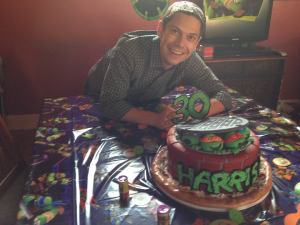
A Brittney creation made this guy happy to turn 30.

A Brittney creation made this guy happy to turn 30.

Katie Turner Carr

katie2I sit next to Katie and pepper her with questions, marveling at how the shy girl I met 23 years ago has blossomed into a self-assured wife, mother and businesswoman. When she left Fort Bragg in 1998 to attend UC Santa Cruz, she never imagined she’d return eight years later to become a sock maven.

It was probably inevitable that Katie became an entrepreneur. During her early years, her father Dave Turner owned a waterbed business in the Bay Area. When these beds waned in popularity and the internet became more consumer-friendly, he began selling waterbed accessories online. He also designed and began to manufacture a layered latex mattress system called a FloBed. Both enterprises allowed him to work anywhere. He fondly remembered growing up in Fort Bragg and wanted to give his four children the same opportunity. In 1992, he moved the family to the area.

Katie’s dream was to be an artist. After graduating from college in 2002, she stayed in Santa Cruz, sold her paintings through local crafts fairs, and made rent money by working at the Sock and Shoe Company. In 2004, her then boyfriend Marshall Carr got a job with Enterprise Rental Car. They moved to Morgan Hill. She worked briefly as a merchandizer for Lowes. “I was miserable. It’s the only job I ever quit.”

She was hired as a manager for Socks Galore in Gilroy. A few months later, the Sock and Shoe Company wooed her back and trained her as a buyer.

Katie3

Katie in her original tiny shop.

By 2006, Katie and Marshall decided their future was limited by the high cost of living in the Santa Cruz area. They hatched a brilliant idea—move to Fort Bragg and open a sock shop. She consulted her dad, who wasn’t convinced it could be successful. He asked her to write a detailed business plan that included statistics on the number of tourists visiting the area and how much merchandise she’d have to sell in order to make a living. After reviewing the plan, he rented her a 200 square-foot space at the front of his FloBeds store on Redwood Avenue.

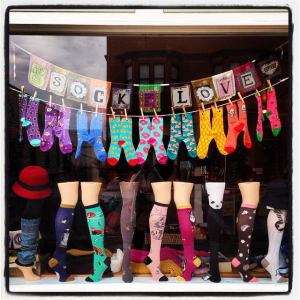
Katie brainstormed names—Sockadeedoda, Sockadelic—before choosing to honor a favorite childhood storybook character—Pippi Longstockings. The tiny shop was off the beaten tourist path, but located across the street from the dance studio. While mothers waited for their children, they’d wander in to buy socks. “It was my busiest time of the day and helped me develop a local following.”

Katie also garnered attention among street people who were enamored with her tiny shop. She fondly remembers a man named Chris who’d stop by frequently, always beginning his visits with “Hey Pippi!” She hasn’t seen him in years, but this nickname is still used by some of her customers.

Katie6When a storefront on Laurel Street became available in June 2008, Katie moved Pippi’s, quadrupling her space and expanding her customer base. She was able to hire employees, which eased her workload and allowed her and now husband Marshall (a high school teacher) to start a family. They have two daughters—Rowan (seven) and Zoey (four).

“I’m so happy to be able to give my kids what I had—the freedom of a childhood in a small town. I want them to be able to play in the woods, on the beach or walk around downtown like I was able to, instead of hanging out in a mall.”

katie7

Sweet Rachel & her great boss.

Katie has two employees. This author is especially fond of Rachel who is kind and patient. Whenever I’m in the shop babbling about something, she’ll smile and say in a soothing tone, “I understand.” She would make a great hostage negotiator or crazy person whisperer.

One of Katie’s favorite things about owning her business is the tourists who get excited to find a sock shop. “They literally squeal with delight.” Returning customers often show her the “Pippi’s socks” they’re wearing and ask to see the socks she has on.

Katie is grateful to live in a small town that has a big community feeling.  “I’m lucky to be a part of a place where one person can make a difference, where the opportunity to participate is just about everywhere. I love knowing my barista, the person who makes my lunch, and the people I support when I shop downtown. I also love that my customers know my family.”

When her dad Dave (the mayor) was the subject of a nasty recall effort last year, Katie wrote a heartfelt blog post defending him which sparked a movement in support of him.

Shortly after the demise of the recall, she joined forces with others to organize Go Fort Bragg, which encourages progressive involvement in the community. “Before this, I didn’t pay much attention to how the city was run. I voted for council members who shared my views and let them do their jobs. I’ve learned that these people aren’t mind readers. They need to hear the opinions of their constituents. I avoid anger and express my thoughts in positive ways. This gives them and others a chance to hear a point of view they may not have considered.”

Katie & her wonderful family.

Katie & her wonderful family.

Katie acknowledges that Fort Bragg has changed since her youth. There was the music store, the old recreation center pool where she was a lifeguard, a tree at Bainbridge Park that was fun to climb. The tree is gone and many businesses have closed. “I can still hang out at Headlands Coffee House, but don’t sit on the sidewalk as much anymore.” She says this with a wink. “The mill is gone, tourism is a more integral part of our economy, but we still have the beach, the woods, and a great community that watches out for one another. We have the CV Starr Center, the coastal trails, and the Noyo Center. A lot of positive changes have enriched our lives.”

Another positive change is Katie’s return. She’s brightened our town with her optimistic attitude and charming sock shop.Katie5

Hilary White

understuff3Hilary White is one of a handful of thirty-somethings who have returned to their hometown of Fort Bragg to run small businesses. Over the next few months, I hope to interview each of them and find out what motivated their return.

I met Hilary years ago when my daughter Laine was in high school and frequented her clothing consignment store, If the Shoe Fits. I was impressed by her gentle kindness and aura of professionalism. A few weeks ago, we sat down for a chat.

Hilary believes people deserve to feel good and surrounded by beauty. “These things bring value to our lives.” This belief lured her back to her hometown and keeps her here. It is also the basis of her business and the goal of her community advocacy. She and three other downtown business owners started the group Go Fort Bragg, which promotes progressive involvement in our town. “When people participate in their communities, it adds value to their lives.”

Go Fort Bragg encourages people with diverse opinions to attend city council meetings. Hilary claims that large audiences give council members opportunities to listen to citizens. She believes one of the values of democracy is that it allows people to express themselves and to hear differing opinions.

When asked to confirm or deny the rumor that she will run for Fort Bragg City Council in the next election, Hilary answered “No.”

“You won’t confirm or deny?”

“No, definitely not.”

“So you’re leaving it open to speculation.”

She laughed. “I will not run for city council in the next election.”

***

After graduating from Colorado College in 2002, Hilary came home to work for a few months at Out of This World in Mendocino. Her plan was to move to New York (where she would rent a room from friends and figure out what to do with her life).

understuff5As fate would have it, she developed the hots for coworker Martin Nakatani. A romance blossomed and she abandoned her New York plans. They eventually married and settled in Fort Bragg.

Like many people along the Mendocino Coast, Hilary had to hold two or three jobs in order to make ends meet. In 2004, she began working at If the Shoe Fits. A mere three years later, she bought the business.

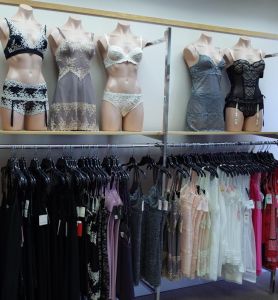
understuff1In 2012, she bought Understuff, an intimate apparel boutique. I wondered what prompted her to make a career in under garments. (Her answer wasn’t nearly as titillating as I’d hoped.) The owner of the store wanted to retire and encouraged Hilary to buy it. Hilary knew it was a viable business and didn’t want to see it close. After a few months, she sold If the Shoe Fits to Fort Bragg native Kerry Hagan and bought Understuff.

Over the years, Hilary has experimented with her inventory to include a variety of clothing—coats, jackets, pants, swim suits and practical pajamas. After the shop moved to Main Street, it gained more tourist traffic. “That’s been fun because it allows me to stock things that might not be affordable for the local market, but are beautiful for everyone to see.”

understuff2

Hilary and her equally discreet employee Nicole.

I tried to get Hilary to share funny stories about her customers, but she declined. Because of the nature of intimate apparel, she must be discreet. I find this reassuring. My brassiere preferences are stored in her computer. I hesitate to think of the stir this would cause should that information be leaked to the public.
Hilary is grateful that owning a business allows her to live in a place she loves. She appreciates being part of a community of downtown business owners who support each other. For example, when she relocated her store, Chriss Zaida of Toto Zaida was part of her moving crew. As Chriss prepares to move her store to Main Street later this month, Hilary and Martin have pitched in to help.

understuff4

Downtown crew helps Toto Zaida prepare to move to its new digs.

As a small business owner, Hilary has learned to adapt to changing conditions and trends. She feels the same holds true for the entire Fort Bragg community. “We don’t have to despair over what we once were [a thriving logging and fishing town] but we can make new things happen, like coastal trails and marine science centers. We can evolve while continuing to respect our heritage.”

Hilary is every bit as great as everyone says. On the surface, she exhibits a grace from a gentler era, dresses with panache, and has excellent posture. I’m happy to let you know that she’s also warm, vibrant, and generous with her laughter. Our town has benefited by her return.