
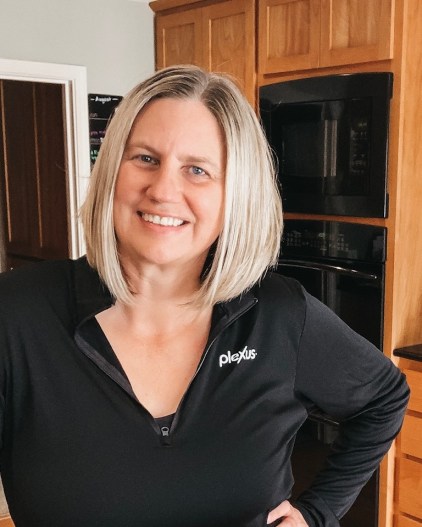
Some people know what they want to become at an early age. Others feel their way into their talents, willing to try to succeed at many things. Misty is one of those, and her life a cornucopia of jobs well done. A fourth generation coastal resident, she hails from a line of entrepreneurs who worked hard to help build our community.
In high school, Misty worked in the office of Anderson Logging (owned by her father Mike). “I loved being part of the family business and am proud to be a logger’s daughter, but didn’t want to make a career out of office work.” In 1995, she graduated from Fort Bragg High and went to Sonoma State where she majored in English and Communications.
While in college, Misty worked as a lifeguard and a waitress. She also wrote for the arts and entertainment section for the Sonoma State newspaper. She eventually became the paper’s news editor. During her senior year, she was hired by “The Ark,” a weekly newspaper in Tiberon. “I was their first intern and covered city council meetings. They gave me a job after I graduated. A woman I worked with taught me graphic design, which I also did for the paper.”
“I loved working there, but after a year, my commute did me in. It was an hour each way from Rohnert Park. My car didn’t have air conditioning. In warm weather, I drove with my windows down inhaling exhaust fumes.”
Fort Bragg was to be a temporary stop until she could find a job in Sacramento where her childhood friend Nick Tavelli lived. “A couple weeks after arriving, my friend Billie Jo Bouldin arranged a blind date with her son Donald Daniels. He agreed to go only if his mom went with us. He wanted to make sure she wasn’t setting him up with a crazy person.”

She and Donald hit it off and her stay in Fort Bragg turned permanent. He worked as a construction foreman and she held multiple jobs. “I was a lifeguard, did graphic design for Erin Dertner, and worked in the Anderson Logging office. After dating for six months, I became pregnant.” Daughter Kylie was born in November 2002. Nine months later, she and Donald married. Son Aidan was born in May 2004.
“We had an infant and toddler, and decided it was a good time to start Daniels Construction.” She shakes her head and laughs. “I’d put the kids to bed and stay up until three in the morning. There was no Google so I studied the book, ‘How to Start a Business.’ The business became official in June 2004.”
When I ask how she possibly managed this, she says, “Donald was working all day. I was raised to never shy away from hard work, to work until you can’t work anymore.”
With the business on its feet, Misty and her mother Maribelle Anderson began a photo essay about Jim Masolini, her father’s maternal grandfather. “My dad was very close to his grandpa and we wanted his memory preserved.” An Italian immigrant, Jim made his way to the Mendocino Coast where he worked on a ranch until he saved up enough money to start the Shamrock, a bar that is now the Welcome Inn. He also owned a number of hotels and the Tip Top Lounge–which housed the town’s first bowling alley.
“My grandma Marie tape-recorded memories of her father that helped me write the story. I used Shutterfly to design the book. A year in the making, we gave it to my dad on his birthday. It was priceless to watch how it deeply it touched him.”
Misty settled into running the construction business and raising children who suffered from skin sensitivities. Son Trey was born in December 2008 and experienced health issues. Misty took them to doctors with little improvement. She was determined to make them well. “I found Edie Bower, a chiropractor at the Casper Wellness Center, who did muscle testing—a non-invasive allergy test. Each tested positive for various food allergies.
“I was skeptical, but I changed their diets. A few weeks later, a well-meaning doctor told me I was wasting my time, so I reintroduced those foods. Everyone had a bad reaction, so I eliminated those foods again.
“As the kids got better, I got sicker. I discovered that foods that are good for gut health—pickled and fermented foods, nuts, avocados—are high in histamines. I didn’t realize they were making my condition worse.
“I developed a rash around my eyes, went to a number of holistic doctors, and nothing helped. I finally went to an allergy eye specialist who prescribed steroid eye drops. Within an hour after application, the rash spread down my face. I stopped using them, but for the next year, had to wear heavy foundation to cover it up.
“In January 2018, a friend told me about a product she sold that works on allergies. I was a health snob and didn’t believe her pink drink could cure me, but was desperate and started using it. I got worse. She said my body was detoxing and this was a natural process. Within a month, the rash started to fade. After three months, it was entirely gone. Nearly two years later, it hasn’t come back. My kids also starting drinking it with great results.”
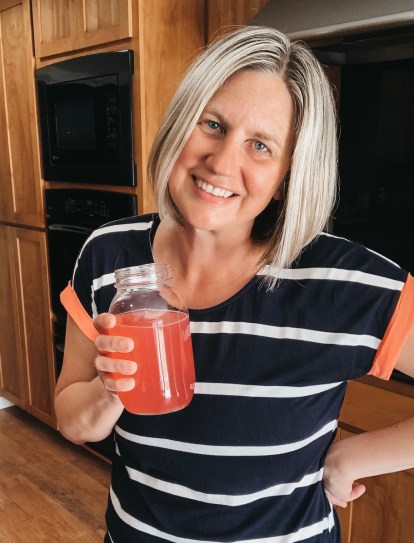
Misty is so enthused about this drink she joined the company that sells it—Plexus—and has customers all over the state. “My business has grown because I forced myself out of my comfort zone. At first, I was hesitant to share because I was concerned about what people would think of me. As I witness my customers reclaim their health, it validates what I’m doing.”
If raising children, focusing on ways to achieve optimum health for everyone in her family, helping run a construction business, and running her own business isn’t enough, Misty is also involved in her kids’ schools and extracurricular activities.
“Two years ago, when Kylie was a freshman, she joined Future Farmers of America. She decided she wanted to raise—of all things—a steer. She ended up with a mean, ornery one. I was amazed at how well she took care of him, but wasn’t sorry to see him go to market. She’s a junior now and raising her third steer.”
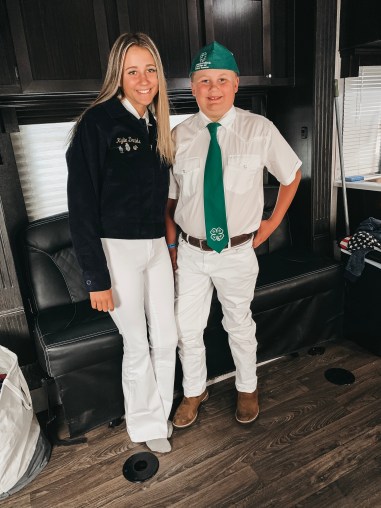
Inspired by his sister, Trey joined 4-H last year and raised goats. “He did a great job and will do it again this year.”
The kids have been involved in sports and participate in late model car racing. Misty’s brother Myles has done this type of racing for years, which attracted her kids to it. “Here I am, an organic mom and my kids are driving race cars.” She laughs. “Kylie started at age eight and Aidan shortly after. Trey has been racing since he was four years old. They love it, but I’ve had to learn to love it.”
Misty embraces the values of her forebearers in raising the fifth local generation of her family. “After my kids leave home, I would love for them to return and serve as reminders of the past. This town was built on strength of character and courage. The old timers knew how to work hard and with determination, despite the dangers in the logging and fishing industries. My kids have watched their parents and grandparents live by these standards, and I hope they choose these for themselves, regardless of profession.”
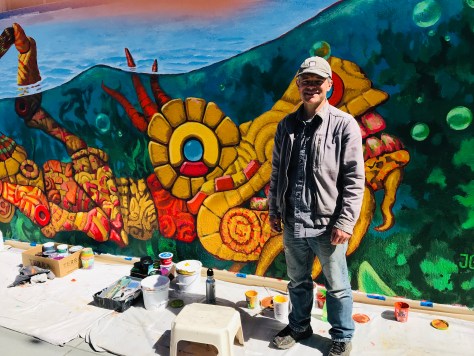 Over the past couple of years, I’ve delighted in the murals popping up on buildings around town.
 Jason was unprepared to be thrust into a different culture. “It was hard at first—dark and hard.” This was back in a day where communication systems were archaic compared to what they are now. International telephone calls were prohibitively expensive and it took a month to receive a letter, all adding to his feelings of isolation.
 By 1997, Jason and Cristina were off to Long Island, New York with their baby boy so Jason could attend Stony Brook University’s MFA program. Cristina eventually entered and completed a PhD program in comparative literature.
 Jason feels lucky to have been able to return to the Mendocino Coast. He loves being near the ocean and the abundance of trees. He enjoys the opportunity to interact with kids on a daily basis. He likes living in the town where his dad has worked for decades as an attorney and to be able to drop by his office for a visit. He gave a warm, contented smile as he said, “When I was growing up in Mendocino, I rarely spent time in Fort Bragg. Now I rarely leave.”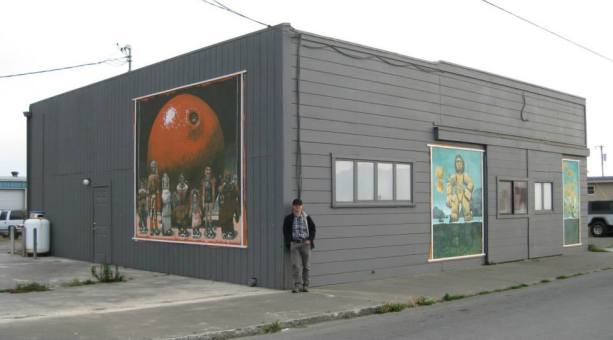
 On January 12, 2019, a fire broke out at Chapel by the Sea, the mortuary that’s been our next-door neighbor for 27 years. It was a terrible, surreal thing to witness. Wisps of light gray smoke from the open upstairs doorway quickly grew into roaring flames that exploded windows and engulfed the structure. Our property was never in peril, but that didn’t keep the fire from reaching across the alley to shake the core of my well-being.
 I woke each morning to the ruins of what was once a stately building. In addition to a mortuary, it housed an upstairs apartment. The Blair and then the Reynolds families resided there during our early years in Fort Bragg, and allowed us to create friendships that endure to this day. We share a common grief over the loss of this beloved place.
 I looked forward to the day—September 17—when the process of tearing down the building would begin. That morning, I headed over there with my camera phone. I vaguely felt like I had when the fire broke out—too terrible to watch, yet demanded to be witnessed. I was relieved it would soon be gone, yet mourned the finality. Over the course of four days, a piece of equipment that looked like a Tyrannosaurus Rex crunched walls, chewed them into pieces, and loaded the debris into massive dumpsters to be carted off.






 Carolina grew up fifth in a family of ten children. She has great respect for her parents and their ability to provide for and raise such a large family. Her father has worked in the logging industry for decades and at the age of 65 is a timber faller. Her mother has been a housekeeper at Stanford Inn since 1997. Her father came to this country when he was 15 years old and worked to send money to help is widowed mother and his siblings in Mexico. He eventually made his way to Fort Bragg and in 1979 brought his young bride.
 Carolina wasn’t the first of 50 first cousins to attend college, but she was the first to graduate. Since then, eight others have obtained degrees. Two of her brothers are currently working and going to college, one scheduled to graduate next spring with a degree in mechanical engineering. Her other siblings are gainfully employed; her youngest sister is a senior year in high school.
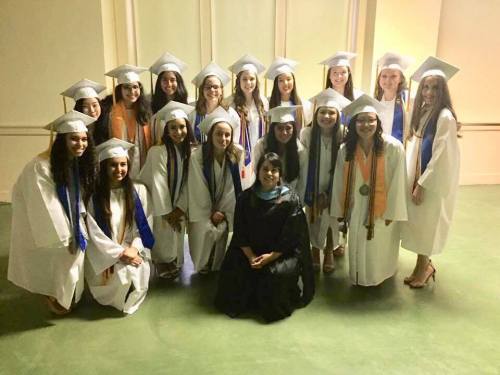 This once shy girl grew into a woman who thoroughly enjoys teaching. “It can be very creative.” During her Master’s program, she became an expert in





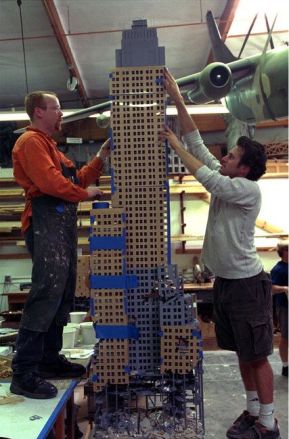



 Apparently many Scandinavians believe that by the time we die, the sum of our possessions should fit into a satchel. I suppose this makes disposal of our property easy for our kids—simply pick up the bag and toss it in the garbage. Being half Scandinavian, I suspect it’s really designed to make us feel guilty for accumulating stuff that makes us happy and comfortable. I was raised with the concept that it’s best to live a life of misery and deprivation.
 In my armoire, I found:
 The last Sunday of January, giddy that the dismal month was coming to a close, I celebrated by getting rid of two pairs of expensive, yet uncomfortable, shoes. Toward the end of the day I realized I hadn’t completed my seven. I went to my closet—the perfect place for unused crap to hide. I spied an old gym bag—some swag from two decades ago. I debated over and shoveled five pairs of shoes inside it.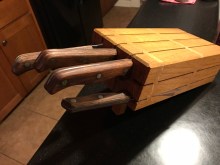
 If you’d asked me how many pairs of sunglasses I own, I’d have said two: a cheap-ass pair bought about 10 years ago and an expensive pair bought two years ago. Imagine my shock to open a cupboard door in my office and find SEVEN PAIRS OF SUNGLASSES!!!


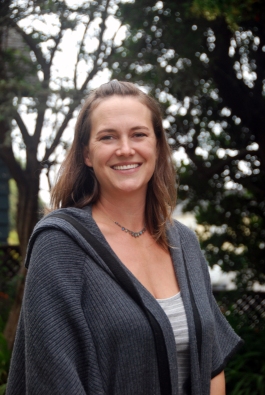 For over 130 years, the Golden West has stood tall on Redwood Avenue in Fort Bragg. Apartments occupy the top two floors and there’s a retail space at ground level, but the building is most noted for its popular saloon.
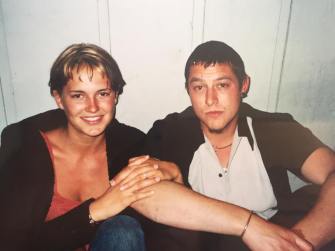 The following summer, she returned to the coast where became friends with Mikael. “We were together for a year and then broke up for a year. After I graduated from college in 2002, I came back and we got together.”
 This was when she and Mikael learned that the Golden West was for sale. They lamented they had no money to make their youthful dream of owning it come true. They heard that the Hospitality House was looking to purchase the building to use as a homeless shelter, and felt an urgency to save it and preserve its history.
 -do attitude, Jessica went to work figuring out how to make it happen. “A financial advisor helped me put together a business plan that turned into a three-inch thick document. After pushing hard, it was clear that traditional financing wasn’t an option. The building had 30 years of deferred maintenance. Private investors also turned us down. We made an offer anyway and went into escrow. At the eleventh hour, the sellers agreed to do owner financing and we got it.”
 The rooms above the saloon were at different times a hotel, boarding house, and brothel. “There are 26 rooms, some of which are used for storage. We have about 16 tenants. When we took over the building I cleaned out a bunch of rooms. It was fascinating—ancient silk curtains, boudoirs, layers of wall paper telling a chronological history.”
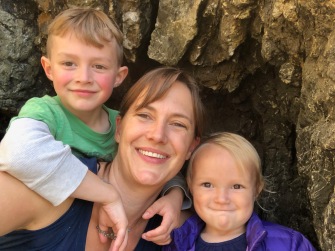 When she was approached with the idea of running for a seat on the city council, it ignited a passion. “The decisions made in the next four years will affect this town for decades. The future of Fort Bragg is critical to me and my family. It’s important that the town’s growth with the mill site and subsequent expansion of infrastructure be done mindfully, in a forward thinking, responsible manner that keeps the soul of our city intact and leverages its natural and historic beauty.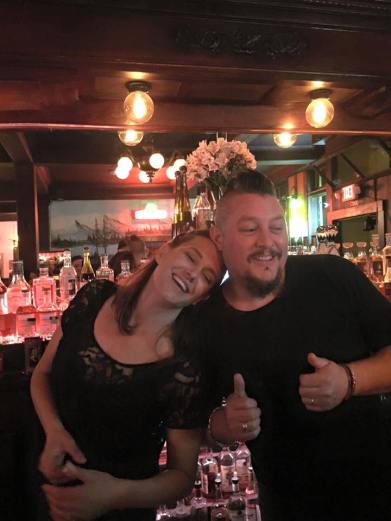

 On the morning of January 20th, I was alerted to a fire at what I called the Hoarder House. I’d never witnessed a fire in real time. It was equally fascinating and disturbing (
 Months went by. Winds and rain caused the waterfall of junk to precariously shift. People started asking me why the City hadn’t torn the place down. I’m flattered they have the impression that I’m privy to the goings on around town. I actually know next to nothing, and often stifle an urge to make things up.
 So what you think Nationstar did?
 A few weeks ago, black tarps were draped over the chain link fence and the demolition began. Within a couple days, the dumpsters supplied by Waste Management were filled to capacity and work paused until they could be hauled inland and emptied.





 Heather grew up in Morro Bay where she learned commercial fishing from her dad. “I moved here in 1999, and immediately began a flaming love affair with Mendocino County.” By 2001, she had saved four thousand dollars and bought a small boat, the Julie. “My idea was to have a floating fish market—to sell fish right off the boat.” She admits that running her own boat was a different experience than crewing with her dad.
 Her dad tried to help her, but she was intent on doing things her way. “At one point, he threw his hands up and said, ‘You’re going to kill yourself,’ and went back to Morro Bay. Bless his heart, he must have been so worried. This strained our relationship, but a few years later, we fished together in Alaska.”
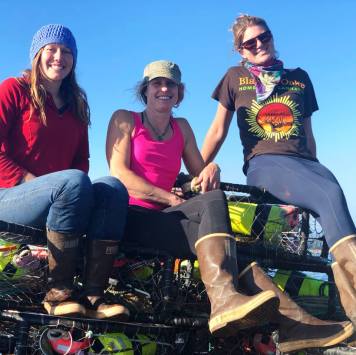 Along the way, she sold the Julie and bought and sold two other boats. In 2009, she purchased a larger vessel with a blast freezer named
 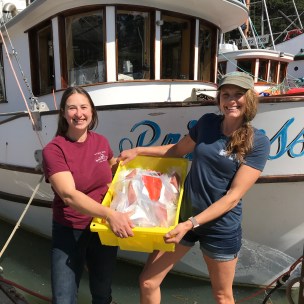 As a woman in this field, Heather is not unique, but rare. “There are a lot more women in Alaska.” She admires her crew which includes Maia and Anna—graduates of Humboldt State. “The salmon season lasts about six months. It requires a great deal of endurance. We get only five to six hours of sleep a night and are away from home so much. I got a crab permit last winter. Catching crab is easier and is a lot more fun.” Maia and Anna also sell the fish at the farmers’ markets.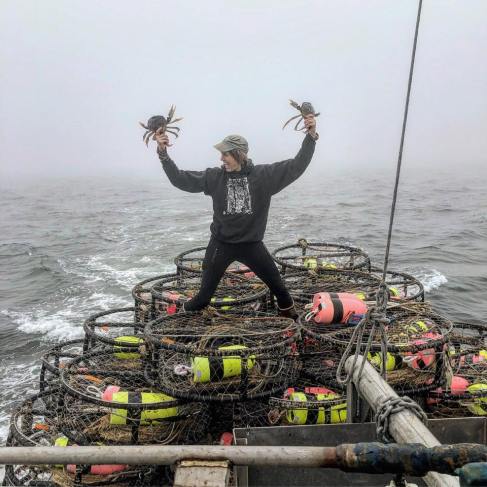

 It Happened at Purity