 “Why of course I know Bryna Turner,” I say to anyone who mentions her name, shamelessly basking in the cast off glow of her newfound celebrity. Her play, “Bull in a China Shop,” recently completed a nine-week run at Lincoln Center in New York City.
Lincoln Center!
Gloria Steinem attended one of the performances.
Gloria Steinem!
“I wrote the play as part of a writer’s group with a very small and scrappy downtown theatre company called Clubbed Thumb,” Bryna said. “As a sort of graduation present from the year-long group, the theatre offered each of us a reading of one of our plays in their space—at two in the afternoon on a Thursday. The director of my reading, Ellie Sachs, had been an intern for the director Evan Cabnet at a summer theatre festival, and invited him to attend. He wasn’t able to, but asked her to send him the script.
“Three days later, he called, introduced himself as the artistic director of LCT3 [the new artists’ wing of Lincoln Center], and said he wanted to produce my play! ‘What do you think about that?’ he said. I said, ‘I think that’s crazy.’ It’s the sort of phone call you don’t dare dream of as a young playwright.”
***
I met Bryna in the spring of 1993 at a children’s fair on Franklin Street. She was three years old. Her brother Packie (five) and my daughter Laine (four) were preschool chums. I didn’t know Packie, but could tell Laine was smitten by the way her face lit up whenever she spoke of their interactions at school.
Shortly after arriving at the fair and before I could extricate her from the stroller, Laine kicked her feet and shouted, “Packie! Packie!”
Like a scene from a romance novel, the five-year-old equivalent of Fabio with a halo of wispy blonde curls strolled through the crowd. As he drew near, Laine’s smile widened, cheeks reddened, her eyes sparkled. Packie returned her smile. He reached out and patted her head.
Laine ripped the bonds of her seat belt and jumped out of the stroller. Packie gave her a hug. His mother Anne appeared, holding the hand of a little girl with piercing blue eyes and fierce red curls cascading down her back—Bryna Turner, future acclaimed playwright.
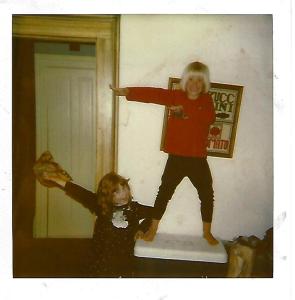 Regular play dates ensued, alternating between the Turner house and ours. It didn’t take Packie long to abandoned them for the rough and tumble company of boys.
The girls established fairly strict guidelines for playtime and generally got along swimmingly. Anne called them the “Little Biddies.” For the most part, each had an appealing, accommodating personality. As the youngest in their families, they’d learned to bury their desires for the greater good. Together, they were equals, and each could insist upon getting their own way—as long as it fit into the rules.
Occasionally, one of them violated a rule. The quarrel that followed was akin to alley cats fighting. No claws sank into flesh, but the yowling and screeching were disturbing. During these times, they were separated. No mediation from the mothers could manage a détente.
Despite sporadic battles, Bryna and Laine enjoyed each other. Their similar temperaments allowed for raucous good fun within the boundaries of civilized behavior, and created a friendship spanning 24 years. When we heard that one of Bryna’s plays was being produced at Lincoln Center, Laine and I couldn’t wait to fly across the country to see it.
***
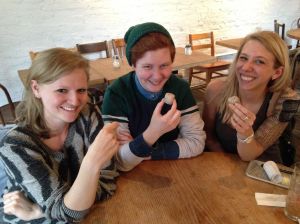 In the fall of 2008, Bryna left Fort Bragg to attend Mount Holyoke in western Massachusetts where she earned a BA in Theater. She went on to obtain an MFA from Rutgers in New Jersey. At the tender age of (almost) 27, she’s written six plays. She lives in Brooklyn where Laine and I met her and their long-time friend Britt Calder for lunch. Afterward, we walked around the area, Bryna and Britt touring us through a neighborhood where mature trees break up the concrete landscape. Raised among the Northern California redwoods, they have a special appreciation for trees.
 We parted with hugs, disappointed we wouldn’t see Bryna at the play that evening. In the first few weeks of the run, she’d hide in the back of the theater, near the light board, and spy on the audience. It was nerve-wracking to anticipate their reaction. Would they laugh at the right moments? Were they paying attention or were some reading their programs? Overall, the response was positive. Still, she found it stressful to watch her work being performed. She’d wait for the closing show to see it again.
“Bull in a China Shop” explores the relationship between Mary Woolley, President of Mount Holyoke College, and her lover, the writer Jeannette Marks which began in the early part of the twentieth century. The play covers 40 years amid the backdrop of women’s suffrage. It is nothing short of genius how Bryna captures the intensity of their coupling, much of it with humor, and all within 85 minutes.
 At the end of the performance, Laine and I stayed in our seats for a few minutes, overcome by the brilliance we had witnessed. “My friend wrote this,” Laine said, her eyes filling with tears. “I’m so in awe of her.”
***
The precision with which Bryna partook in childhood games is evident in this play, which was described in a glowing review by the New York Times as “pugnacious, tender and gloriously funny….” We were thrilled to witness the success of a gifted artist who is also a highly intelligent and compassionate human being.
This is just the beginning of Bryna’s bright career. LCT3 is paying her a commission to write her next play. In June, there will be a reading of her play “Carlo at the Wedding” at the Abingdon Theatre in New York City.
I am honored to know Bryna Turner. I hope she forgives me for dropping her name from time to time.

 Myles is a fourth generation logger who has loved being in the woods for as far back as he can remember. However, a decision made the year before he was born might have sent his life on a different course.
 “In 1975, my grandpa was a silent partner with Bud Eastman and they decided to liquidate part of their logging business and put some equipment up for auction. Grandpa wanted to invest in a hotel and bar, but my dad [Mike] had just graduated from Humboldt State and wanted to start a logging business with him. Dad convinced him to buy a truck and some equipment from that auction.” Thus, Anderson Logging was born.
 While he was in high school, the guys in the shop taught Myles how to grease and maintain trucks. He did this after school and during summers. When he turned 18, he got to fulfill his dream of working in the woods. “I set a lot of chokers,” he said with a smile. A choker is a small piece of cable used to attach logs to cable systems, allowing trees to be harvested without dragging them along the ground. “I really liked it and would have kept at it, but Dad had me work all the jobs so I could learn what the business entailed.”
 Mike didn’t want Myles to jump right into the business. “It would have been easy for me to head straight into it after high school,” Myles said, “but Dad wanted me to see other places and learn other things before deciding how to spend my life. He knew how much work is involved in this and hoped I would find something easier, but every time I was away all I wanted was to get back to logging. I really enjoy being out in the woods working with the guys. However, I’ve learned there’s a lot more behind the scenes to keep the business going, and that part is not as much fun.”
 Myles enjoyed college where he majored in Ag Engineering. When he was a senior, he and two friends wanted to build a tractor—from the ground up. “Each year, students in the department would build a sled to be used in tractor pulls. All prize money goes to student scholarships. The dean approved the tractor as long as we found sponsors to cover the cost.” Myles and his buddies were often in the machine shop until two or three in the morning. “We got to know all the campus cops. A woman cop sometimes brought us pizza.” Over the past 18 years, the tractor has been driven by 70 different people in 300 pulls.
 During the logging season, Myles routinely works 13-hour days. “The season used to be about seven months, but now it’s often eleven. Since the recession, logging capacity has shrunk. In order to fulfill the needs of the mills, our seasons have gotten longer. The ability to work during the winter has always been there, however regulation requires rocked roads. In the past, landowners haven’t wanted the additional cost that brings to the process.”
 Myles isn’t the only one in his family who works hard. He’s married to Stacey, a dynamic young woman who he knew in high school. They reconnected in 2003 when her son Wyatt (by a previous relationship) was two years old. Their son Lane was born in November 2006.

 When Josh’s girlfriend Lia Wilson told me what he does for a living, I simply had to meet him.
 Josh worked three part-time internships. He monitored the news and developed press kits for Environmental Media Services, a non-profit environmental public relations firm. He worked for filmmaker John de Graaf in coordinating the first Equinox Environmental Film Festival (later named for Hazel Wolf), soliciting in-kind donations and arranging other details. At
 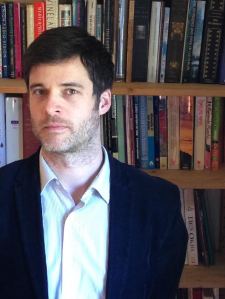 In August 2011, he moved to Berkeley and became a private investigator with the Mintz Group, a multinational firm. A friend referred him, but he got the job because of his law office and writing experience. “We conduct a variety of investigations, none having to do with cheating spouses.” He laughs. “We focus mainly on three areas: due diligence, including extensive background checks on candidates for high level corporate jobs, and background checks prior to business deals; disputes, which means uncovering whatever it is lawyers need to know for a given lawsuit; and anticorruption. Under the Foreign Corrupt Practices Act, it is illegal for American companies to pay bribes to win job bids in foreign countries. Sometimes companies will contact us to investigate the practices of their employees abroad. We have offices in Asia, Latin America and Africa, as well as the U.S., Canada and London.”
 As a teenager, Kerry devoured Vogue magazine. “Fashion is an art form—not just something to cover your body with,” she said. “From runway couture to black yoga pants, it gives you an opportunity to express your inner self in ways large and small, obvious and subtle.”
 Because of her deep love of fashion, it makes sense that Kerry would eventually own a clothing store. But first she would graduate from high school and tear out of town to travel the country before returning to hold two to three jobs at the same time in order to make a living.
 In 2011, Hilary White asked her to work one day a week at If the Shoe Fits—a consignment clothing shop on Franklin Street. “A year later, Hilary took me to dinner and said she was buying Understuff. She added, ‘I want you to buy If the Shoe Fits.’
 and taproom with food currently under construction on Elm Street (north of town near the old bowling alley). They hope to open in early summer 2017. When that happens, she’ll work three to four evenings a week in addition to running her store. When I marvel at her ambition, she says, “I’ve never been afraid of having multiple jobs.”
 I met Laura Lee 24 years ago when she was 19 years old. I was captivated by her name—one that seems suited to a line of specialty dairy products—perhaps yogurts and cheeses—some type of creamery to reflect her wholesome sweetness. From our very first meeting, I could tell she is a person who leads from the heart.
 Laura is sometimes astonished that she’s worked at Feet First for over 20 years. “It’s given me a chance to build cherished friendships. I’ve met a lot of people in our community and returning visitors. One of my favorite parts is watching the kids grow up. There are kids I’ve known since I helped tie their shoes who now bring their own children into the store.”
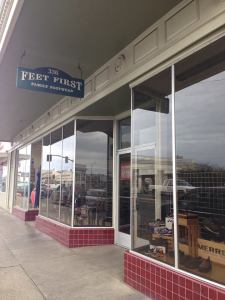 Like most businesses, Feet First has changed over the years. “I remember when athletic shoes were mostly white with a little color pop. Now it’s all about the colors. Right now, leisure shoes are taking on a look inspired by athletic shoes. When the [Georgia Pacific] mill was open, work boot sales were steady. We still sell them, but hiking boots are more popular among men.”
 Recently, she’s started calling friends and arranging gatherings. “You know how it is when you run into people and say ‘We have to get together soon’ and you never do? Well, I’m telling people, ‘Now’s the time.’ When the weather improves, I’m going to invite people to bonfires at the beach after work.”
 I sat down with Justine Lemos, owner of at
  Justine was awarded a prestigious Fulbright Scholarship in 2003 which allowed her and Grady to live in India for 10 months while she researched ancient forms of Indian dance. “We lived in remote village in the southwestern part of the country. In order to buy anything refrigerated, we had to travel an hour and a half by local bus.”
 Justine taught online classes—Cultural Anthropology, World Dance, Linguistic Anthropology, Anthropology of Art—through colleges in Southern California. She often worked on her laptop at The Company Store. When the flower shop in the building went of business, she thought, “That should be a yoga studio.”
 Justine has mixed feelings about being back home. “I was gone for fifteen years and never thought I’d return. But I compared everywhere I lived to here and those places always came up short.” She feels limited career-wise, but grateful to be able to raise her son near her parents. “I had a special relationship with my grandparents, and I’m happy Ravel is having the same experience.”









 It Happened at Purity