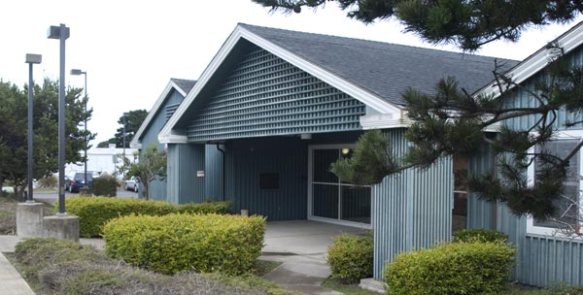
I sit in the Ten Mile Justice Center courtroom in Fort Bragg, legs crossed, right foot bobbing in an effort to dissipate my nerves. I’m here for the second month in a row to request a continuance on a restraining order I was reluctant to file, but that law enforcement has encouraged me to pursue.
My lower back starts to painfully throb. I concentrate on taking deep, slow breathes, which manifest as shallow asthmatic wheezes. I want to cut and run.
The cases previous to mine are mundane—the opening of probate, something about a family trust, and an illegal eviction. About a half hour after court comes to order, someone enters through the back door. I don’t know who because I’m sitting in the front row of the gallery. The person sits behind me to the right of my peripheral vision. Cigarette fumes give me a nicotine contact high. All I can see of this person is orange and gray athletic shoes.
The judge calls a case for a someone named Bob (not his real name). The guy sitting behind me stands and moves forward. He’s a trim, grizzled 50-something who wears capri-length workout pants and a tank top with three horizontal slashes across the back. I’m somewhat alarmed that he seems to have ignored the posted rules for appropriate court attire—no shorts, no tank tops. His blonde streaked hair is combed forward and he’s got a healthy tan. If he were a few decades younger, he’d look like an attractive surfer dude.
The previously bored bailiff stands and rests his hand on his pistol.
The judge informs Bob the restraining order against him has been dropped. (This order has nothing to do with my case.)
“So I can go back to Ukiah?” Bob asks, incredulous.
“I cannot tell you what to do,” the judge says.
“I’ve been living in Ukiah getting my life together,” Bob announces proudly. “I’m off meth.”
“Good for you,” the judge says with genuine warmth.
“I have some clothes at that house. Can I get them before I leave town?”
“I cannot tell you what to do,” the judge says.
“Since the restraining order’s been dropped, I can go pick up my clothes?”
“I cannot tell you what to do.”
Bob shakes his head as if to dispel water from his ears. “I just wanna tell ya,” he says, “you’re the best. The best!” As if the judge had something to do with getting the complaining party to drop the restraining order.
“Thank you. You’re free to go.”
“I won’t forget this.” Bob turns to leave. “You’re the best. The best!” He’s giddy, pumping his fist in the air like his favorite team just won the World Cup.
The bailiff sits down.
I make note of Bob’s full name in order to later check the online Mendocino County Sheriff’s Booking Log. I’m certain—willing to put money on it—that he’ll be arrested before nightfall for causing a kerfuffle at a house where nobody wants him, yet where some of his clothing still resides.
After he leaves, my case is called. For Bob, my experience would have been a day at the beach. For me, it was stressful enough to send me home to lay on the floor with an ice pack under my back and feeling what Southern women used to call “having a case of the vapors.”
The party I’m seeking a restraining order against, someone who made an obsessive series of calls to my home, someone who is well known to law enforcement, has a right to be served with notice of the filing. He cannot be found. I’m granted my continuance, but scheduled to return the following month. I want nothing more than to have this process over and done with, but fear I’ll spend the bulk of 2019 going to court.
A few days later, I remember to check on Bob to see if he escaped arrest the evening following court and made it safely back to his new life in Ukiah.
Exactly one week before his appearance in the coast courtroom, he was arrested in Fort Bragg for being a public nuisance. He was held overnight.
The day after his release, he was arrested in Ukiah (about an hour and a half drive from Fort Bragg) for disorderly conduct: alcohol, and held overnight.
Two days after that release, he was once again arrested in Ukiah on the same charge and held overnight.
The following day, he appears in the Fort Bragg courtroom to make it a matter of public record that he’s getting his life together.
Bob might have issues with substance abuse and appropriate public decorum, but the underlying struggles he’s dealing with have been visited upon all of us to some degree or another.
We’ve all made the Monday morning promises—“I swear to God I’m going to (fill in the blank).”
- Quit smoking. Until you can no longer suppress the desire to chop someone’s head off (usually by noon on Monday when you bum a smoke from a co-worker).
- Quit drinking. Until you get home after a stressful Monday at work.
- Go on a diet. Go to the gym. Get in shape. Until, on your way home from work, you stop by McDonald’s for a value meal to pair with your tequila shots.
- Give up that toxic girlfriend or boyfriend. Until 10:00pm when you start drunk texting.
Yeah, yeah, yeah—we’ve all made such proclamations, and we’ve all inevitably failed until for some reason—grace?—we follow through and actually turn things around.
Like a worried mother, I visit the booking log website every few days to check on Bob. I’m hopeful he’ll stay out of trouble for good—or at least for a time. Five days after I’m made aware of him, he’s arrested again in Ukiah for—you want to take a guess?—disorderly conduct: alcohol.
At least he’s not on meth, I tell myself.
Twelve days later, he’s arrested in Ukiah for indecent exposure.
I hope Bob eventually finds the grace to overcome his demons and find peace.
I hope I eventually get my own act together and stop checking on him.






 Apparently many Scandinavians believe that by the time we die, the sum of our possessions should fit into a satchel. I suppose this makes disposal of our property easy for our kids—simply pick up the bag and toss it in the garbage. Being half Scandinavian, I suspect it’s really designed to make us feel guilty for accumulating stuff that makes us happy and comfortable. I was raised with the concept that it’s best to live a life of misery and deprivation.
 In my armoire, I found:
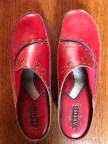 The last Sunday of January, giddy that the dismal month was coming to a close, I celebrated by getting rid of two pairs of expensive, yet uncomfortable, shoes. Toward the end of the day I realized I hadn’t completed my seven. I went to my closet—the perfect place for unused crap to hide. I spied an old gym bag—some swag from two decades ago. I debated over and shoveled five pairs of shoes inside it.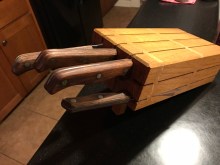
 If you’d asked me how many pairs of sunglasses I own, I’d have said two: a cheap-ass pair bought about 10 years ago and an expensive pair bought two years ago. Imagine my shock to open a cupboard door in my office and find SEVEN PAIRS OF SUNGLASSES!!!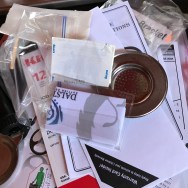


 We moved to Fort Bragg 26 years ago when our children were very young. Our house is across the alley from Chapel by the Sea, the town’s only mortuary. It was the summer between kindergarten and first grade for our older child Harrison. He had no friends and a limited capacity to interact with his three-year old sister (and his parents). At the time, Larry Blair was a partner in the mortuary and lived in the upstairs apartment with his wife Shirley and teenage daughter Charla. Older daughter Charise was married to Nathan who worked for Larry. They lived in the alley apartment.
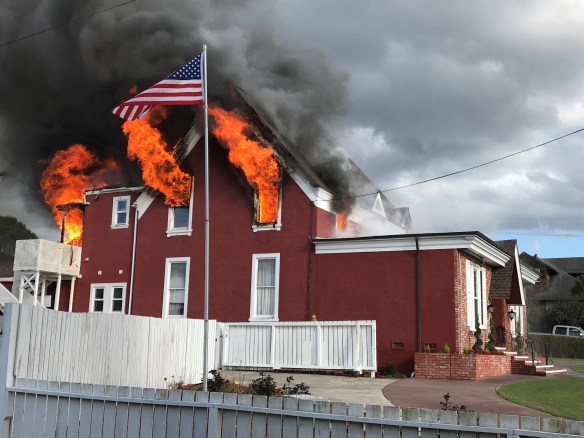 A flurry of law enforcement arrived to cordon off the street. Neighbors gathered, some inside my fence, all of us sharing looks of horror and tears. We watched the smoke grow in volume and black intensity. I cried for it to stop. This stately building stood for over 100 years, the past 26 years as our neighbor. This couldn’t be happening—STOP!
 About 4:30pm, the fire department had contained the blaze and began wrapping up. I am in awe at how, despite the chaos of the fire, they maintained their professionalism and focus. Heavy hoses had been dragged about the property, yet they did not damage one plant of the major landscaping project that was completed this past fall.
 After a fitful night of little sleep, I rose the following morning worried about Julie. I didn’t want to, but couldn’t help, looking out our east windows to a sight I’ve always revered. It was horrible—a burnt out shell of a once stately building. My sadness runs deeper than I could ever have imagined. I can’t fathom how I’ll face this mutilated scar in the coming days and weeks.
 For now, I try to find consolation in the fact that even though the monument is gone, the love it symbolized remains. Charise, Charla, Katelyn, Jacob, Nick, the Blairs and my family share a common grief, but we also share a special bond that will carry us through.
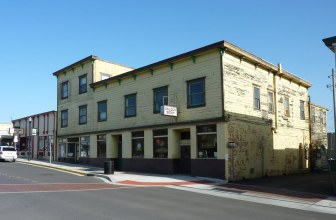
 For over 130 years, the Golden West has stood tall on Redwood Avenue in Fort Bragg. Apartments occupy the top two floors and there’s a retail space at ground level, but the building is most noted for its popular saloon.
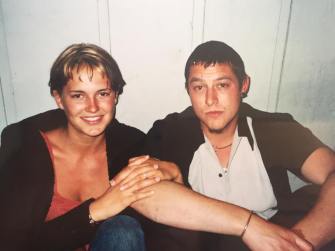 The following summer, she returned to the coast where became friends with Mikael. “We were together for a year and then broke up for a year. After I graduated from college in 2002, I came back and we got together.”
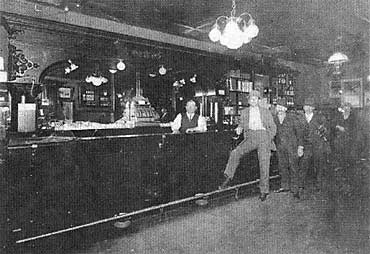 This was when she and Mikael learned that the Golden West was for sale. They lamented they had no money to make their youthful dream of owning it come true. They heard that the Hospitality House was looking to purchase the building to use as a homeless shelter, and felt an urgency to save it and preserve its history.
 -do attitude, Jessica went to work figuring out how to make it happen. “A financial advisor helped me put together a business plan that turned into a three-inch thick document. After pushing hard, it was clear that traditional financing wasn’t an option. The building had 30 years of deferred maintenance. Private investors also turned us down. We made an offer anyway and went into escrow. At the eleventh hour, the sellers agreed to do owner financing and we got it.”
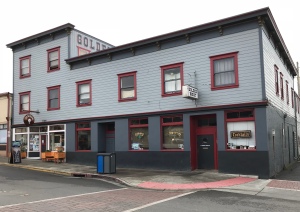 The rooms above the saloon were at different times a hotel, boarding house, and brothel. “There are 26 rooms, some of which are used for storage. We have about 16 tenants. When we took over the building I cleaned out a bunch of rooms. It was fascinating—ancient silk curtains, boudoirs, layers of wall paper telling a chronological history.”
 When she was approached with the idea of running for a seat on the city council, it ignited a passion. “The decisions made in the next four years will affect this town for decades. The future of Fort Bragg is critical to me and my family. It’s important that the town’s growth with the mill site and subsequent expansion of infrastructure be done mindfully, in a forward thinking, responsible manner that keeps the soul of our city intact and leverages its natural and historic beauty.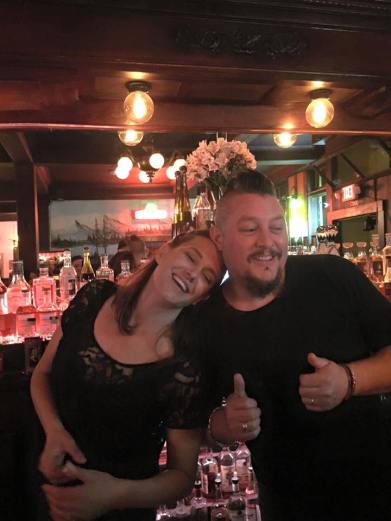

 On the morning of January 20th, I was alerted to a fire at what I called the Hoarder House. I’d never witnessed a fire in real time. It was equally fascinating and disturbing (
 Months went by. Winds and rain caused the waterfall of junk to precariously shift. People started asking me why the City hadn’t torn the place down. I’m flattered they have the impression that I’m privy to the goings on around town. I actually know next to nothing, and often stifle an urge to make things up.
 So what you think Nationstar did?
 A few weeks ago, black tarps were draped over the chain link fence and the demolition began. Within a couple days, the dumpsters supplied by Waste Management were filled to capacity and work paused until they could be hauled inland and emptied.





 Heather grew up in Morro Bay where she learned commercial fishing from her dad. “I moved here in 1999, and immediately began a flaming love affair with Mendocino County.” By 2001, she had saved four thousand dollars and bought a small boat, the Julie. “My idea was to have a floating fish market—to sell fish right off the boat.” She admits that running her own boat was a different experience than crewing with her dad.
 Her dad tried to help her, but she was intent on doing things her way. “At one point, he threw his hands up and said, ‘You’re going to kill yourself,’ and went back to Morro Bay. Bless his heart, he must have been so worried. This strained our relationship, but a few years later, we fished together in Alaska.”
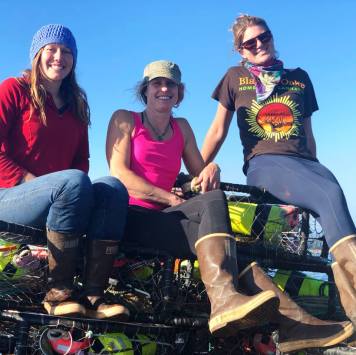 Along the way, she sold the Julie and bought and sold two other boats. In 2009, she purchased a larger vessel with a blast freezer named
 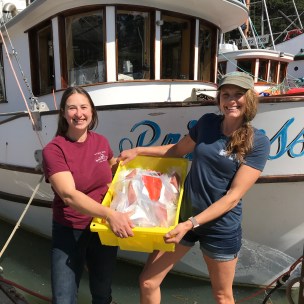 As a woman in this field, Heather is not unique, but rare. “There are a lot more women in Alaska.” She admires her crew which includes Maia and Anna—graduates of Humboldt State. “The salmon season lasts about six months. It requires a great deal of endurance. We get only five to six hours of sleep a night and are away from home so much. I got a crab permit last winter. Catching crab is easier and is a lot more fun.” Maia and Anna also sell the fish at the farmers’ markets.


 After college, she moved home to Fort Bragg in 2012 to regroup and figure out her next move. She was 22. “I picked up some shifts at Los Gallitos, worked for Carol Millsap for a year, and took on overnight shifts for Andersson Caregiving, caring for elderly and terminally ill people. This was one of the most significant jobs I ever had, getting to care for people in that way. Each experience taught me something and made me a better person. It reminded me we’re all going to grow old and die. It caused me to be less self-centered.”
 She returned in the fall of 2013 to take a full time position at Project Sanctuary as a client advocate and counselor. When the organization received a sexual assault prevention grant, Karina was hired to conduct community outreach with other agencies—Safe Passage, the Children’s Fund, Gang Awareness and Prevention. “We disseminated information about healthy relationships, especially among teens. I provided in-service to groups like the Catholic church’s youth groups and held lunchtime meetings at the middle school and high school. At Fort Bragg High School, I organized the Youth Leadership Team, a group focused on teen education and awareness, which still exists today.”
 Her first year entailed teaching a World Culture and Language class to sixth graders and a couple of Spanish classes to seventh graders. “This year, I had to add a second level Spanish class for the eighth graders. It’s the equivalent of high school Spanish I.” She teaches separate Spanish classes for native speakers. If all that isn’t enough, she also teaches a seventh grade AVID (Advancement Via Individual Determination) class on critical thinking and study skills.






 Sometimes the inspiration to move back to the place you love arrives in the most random of ways. An email sent by your wife, added to the hundreds you received that day, nearly lost until a couple weeks later when you find it and ask why she sent you a link to a house for sale in Fort Bragg. She knows how your long work days often spill into late nights and take a toll on your personal life. Since leaving the Mendocino Coast over 20 years ago, you’ve always said you’d move back. Maybe now is the time.
 Jason was born in Houston, Texas and moved to Elk with his mom Laurie Graham when he was seven years old. “My mom’s whole life was her children, but she was always willing to open her home to a friend in need. She loved nothing more than spending time with family and friends.”
 Those were the days before cell phones, when a homesick kid had to pay for long distance calls if he wanted to talk to his mom. Jason didn’t have this luxury. He got an on-campus job as the audio visual tech manager at the student union. He eventually became the building manager.
 He bought a condo near San Jose State and rented out a bedroom, usually to a college student. “In 2009, a friend told me her friend Cate—who lived in Willits—was planning to go to San Jose City College and needed a place to stay. I rented her the room.” They began spending time together and slowly became a couple. They married in 2013.

