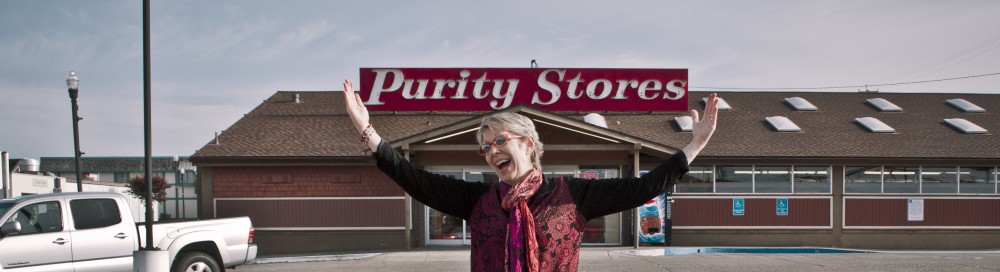
 When I first heard Mindy Slaughter on the radio as the voice of Sport Dodge a few months ago, her upbeat tone and energy impressed me. She must have had this effect on others, too, as random people encouraged me to contact her for an interview. Her warmth, intelligence, and easy laughter made me glad I did.
It’s been nearly 14 years since Mindy graduated from Mendocino High and went away to college. That entire time, she felt compelled to return home. “Even though I was born in Ukiah and lived most of my childhood there,” Mindy said, “I say I’m from the Mendocino Coast.”
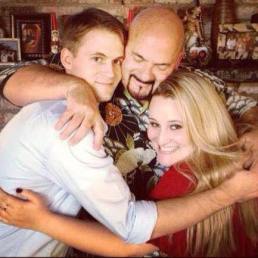 In January 2000, her dad Mike and business partners bought Jack Smith Dodge in Fort Bragg. She was in the ninth grade, her brother Matt in the seventh. “I was excited about moving to the coast, but stayed in Ukiah with my mom to finish the school year. That summer, Dad introduced me to the high school basketball coaches for Fort Bragg and Mendocino. I got to practice with both teams.”
Mindy felt a kinship with the Mendocino team and decided to attend their high school. “It was the best decision. There were 72 in my graduating class. We were like a big extended family.”
In 2004, during her senior year, Mindy was accepted to Saint Mary’s College. Her mom Mary fell gravely ill with a fifth bout of breast cancer—a disease she’d been battling for 10 years.
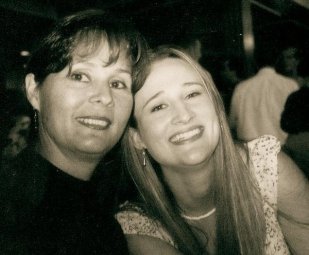 “On prom night I got dressed in her hospital room. The nurses decorated it with our prom theme—Mardi Gras—and helped us celebrate.” A month later, Mary was deemed too frail to attend the graduation ceremony. “Her nurse Kathy Lang and Kathy’s policeman husband Joe sprang her from the hospital and took her anyway.” Mindy smiled at the memory.
Mindy deferred her admission to Saint Mary’s and enrolled in Mendocino College in Ukiah. “This allowed me to come home on the weekends to be with my mom in the hospital.” The love and tenderness with which this was said broke my heart.
In October 2004, Mary passed away.
“I stayed at Mendocino College and got my AA degree in Business Administration. By that time my brother had graduated from high school. He was headed to Sacramento State and I went with him.
“My plan was to finish college and come back to Fort Bragg.” A click of a computer button derailed that plan for over a decade.
“In 2007, Jeep was sponsoring a Tim McGraw and Faith Hill concert at Arco Arena in Sacramento. My dad got sponsor tickets and gave them to me. I went on the Arco website to check the seat locations and saw an announcement for a marketing internship with the Sacramento Kings. I applied and got a call that the positon had been filled, but there were other unpaid internships available in Sales and Service.
“I was hired and the part time internship quickly grew to 30-40 hours a week. I did this for about seven months while also going to school fulltime. I finally told my boss I needed a paying job. A couple weeks later, I was hired as his assistant.
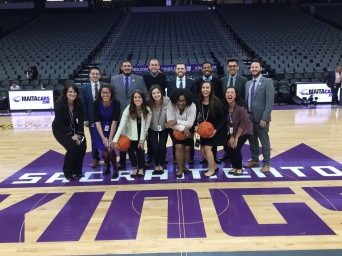 “In June 2008, the Services Coordinator position for the Sacramento Kings became available. I applied and started a week after I graduated.”
During her years with the Kings, she was able to learn many aspects of running an NBA team—marketing, event operations, fan experiences, sales, membership services, and public relations. Although the work was challenging and required long hours, she loved it.
In the fall of 2011, she got a call from a former mentor who was working for the University of Oregon Ducks. “He encouraged me to apply for the athletic department’s Event Manager job at the new Matthew Knight Arena. I love doing events. At the time, there was talk of the Kings moving to Los Angeles or Seattle. Employees were leaving and not being replaced.
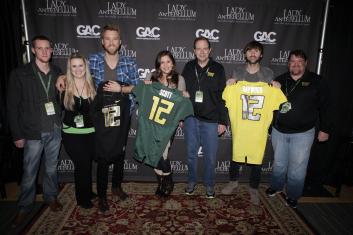 “I got the job and moved to Eugene in November 2011. I was 25—eager to do the work and learn. Professionally, I was fulfilled—I got to help with the Olympic trials and an appearance by the Dali Lama. I had the opportunity to learn and do more than most who spend years in this type of role. But personally something was lacking. It was hard living in a town where people are either college students, young marrieds with children, or retired. My heart was in California. I missed home.”
In June 2013, Mindy’s former Kings boss called to say the team had sold and was staying in Sacramento. He offered her the job of Manager of Membership Development and Sales (a department she’d helped start). She jumped at the chance to return to California and be closer to her family.
Her return coincided with the building of Golden 1 Center—the new Kings arena in downtown Sacramento—which was slated to open for the 2016-17 season. “We had to move 12,000 season ticket holders to seats in an arena which wasn’t laid out like the old one. We were prepping for the upcoming season at Golden 1 Center while closing out the last season at Arco Arena. There was so much adrenaline, it was so much fun. There were times I spent the night in my office. Looking back, someone should have stopped me.” She laughed.
With the new arena open, season ticket holders happily seated, and her eighth basketball season under her belt, Mindy began talking with her dad about wanting to apply the knowledge she’d gained to something new and challenging. “I always said I’d move back to the coast and work alongside my dad at the dealership. He suggested this might be the time to do that.”
When Mindy gave her notice, her boss asked what she needed in order to stay. “I told him this wasn’t about money or my job title. It was time for a change. I wanted to go home.”
In September 2017, Mindy became General Manager of Sport Dodge. “I feel like a great weight has been lifted from my shoulders. I feel grounded. It makes me happy when people come into the dealership to meet me after hearing my voice on the radio.”
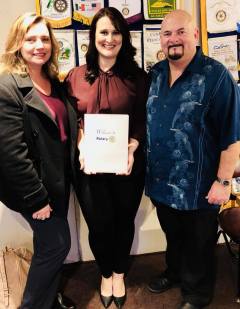
With step-mom Clara and dad Mike.
One of her favorite aspects of small town living is how people have a vested interest in the well being of others. “You can make a true hands-on difference here. Dad has been a Rotarian for years. In January, I had the privilege of being inducted into the club. It was such a proud moment. It’s important for us to give back to this wonderful community.”
Mindy is delighted to find that the concept of shopping local is more widely accepted than it was years ago. However, she’s concerned that we’re not an active youth community. “I’m in favor of youth leaving for education and experience. There’s so much to learn and observe in the world. I’d like to see more of them return to share their knowledge. We have such great potential to become a thriving economy while maintaining our small town feel.”
She’s proud that the dealership employs 21 people, most of whom were born here or have been members of this community for a long time. She looks forward to helping the business continue to expand and grow.
“After my mom passed, I steered away from having a personal life. I put all my time into school and work. It’s all I really wanted to do.” Returning to her beautiful hometown is helping Mindy find a balance between the two.

With the Sport Dodge crew.
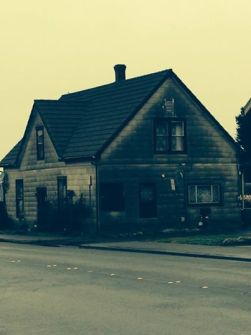 On one of my walks with my dog Lucy a few years ago, I discovered a house three blocks west and one block south that had all the hoarding signs—disintegrating drapes that were perpetually closed in downstairs windows, paraphernalia piled against upstairs windows, a backyard that looked like a combination of junkyard and garbage dump. My fascination with it caused Lucy and me to walk by on a regular basis.
 In the late morning of January 20, a friend called to say “my house” was on fire. I rushed to the scene to see firefighters battle toxic smoke spewing from the asbestos-singled structure. It was riveting to watch a firefighter stand high in the air on a truck ladder and spray hundreds of gallons of water on the house. When the smoke dissipated, the spray stopped. Within moments, the smoke started up again. All that water—and still there remained a deep burning that refused to surrender.
 The next day and the day after that and the day after that, I drove by. The house is in shambles—an astounding collection of possessions destroyed and caved into a monstrous heap. I was surprised to discover that underneath the shingles is a wooden gingerbread design. A lifelong coastal friend told me that in the fifties and sixties a number of people covered old houses in this way to make them appear more modern.
 According to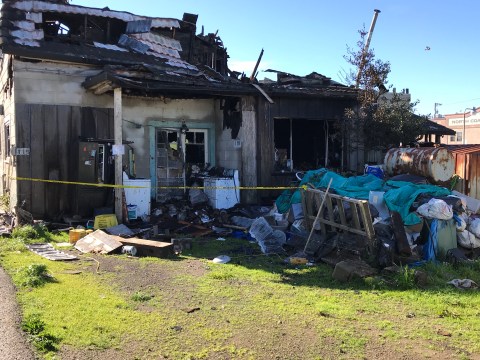






 After graduating in 2002, she entered an 11-month AmeriCorps program. “I wanted to start paying off my loans, and AmeriCorps offered money towards that. I also thought it would be a fun break from life—which it was. It gave me time to decide what I really wanted to do.” She became part of a team of ten people in Denver. “We traveled to a number of states where we did jobs like state park trail maintenance and renovating a playroom for a summer program that offered homeless children a place to learn, play and socialize.”
 She once again worked as a waitress while studying for her California boards, which she passed in March 2010. Shortly afterward, she opened her business in the office complex behind Taka’s Grill. For the first few years, she supplemented her income by working three to four days a week at Lee’s Chinese. “Word of mouth has been a big factor in my growth. When I started accepting health insurance and Medi-Cal, my clientele also grew tremendously. I still work one day a week at Piaci’s. I love my profession, but like getting out and socializing. Waitressing does that for me.”
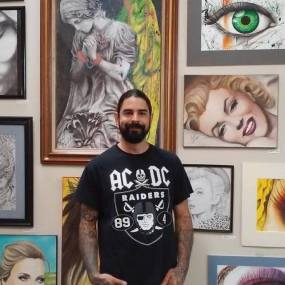 She lives on the same property as her parents and shares a home with her partner Garrett Barker and his two children. “Garrett was born in Southern California, but lived in Fort Bragg off and on while he was growing up. He came back in his twenties and has been here ever since. He’s an amazing artist and also works for a machine shop in Comptche.”
 She’s sad that Fort Bragg doesn’t offer the same sense of community as when she was growing up. “I don’t see a lot kids riding bikes. I no longer know nearly everyone. I used to know the names of our homeless people. I don’t anymore. It’s especially hard for single people to live here—there aren’t many places to mingle.” However, she does admit that the Golden West Saloon—purchased a few years ago by a couple in her age group—has helped provide a social outlet for the younger crowd.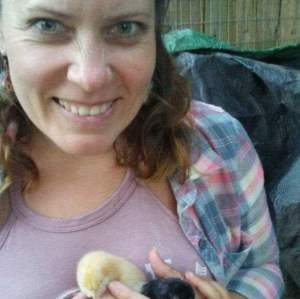

 If you’ve never had a colonoscopy, you may not understand why the term torture is associated with it. This applies to the day before. The patient is allowed to ingest only clear liquids, which by mid-morning sets off a primal alarm in the brain—the process of starving to death has begun. By mid-afternoon the brain partially shuts down and the patient wanders zombie-like through the rest of the day. She occasionally snaps into reality and tries to keep the whining under control by reviewing all the things she should be (but truly isn’t at that moment) grateful for: family, friends, shelter, blah-blah-blah, and good health insurance.
 After a fitful sleep, the following morning begins at four o’clock with another round of the cocktail. Kate wants to cry, but remembers there are a bunch of people in the world suffering a great deal more than her. She tries once again to concoct a gratitude list, but cannot think of a single thing.
 If you’re walking east along the 200 block of Redwood Avenue, you’ll notice a difference in the
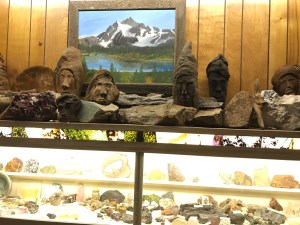
 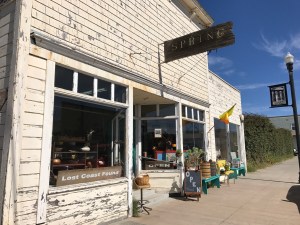 Part of this renaissance is due to the opening of the vintage shop Lost Coast Found, housed in the same location and owned by Megan Caron—a homegrown girl who returned after living in Petaluma for 16 years. “When Larry died [in 2009], he left the building to Heather Brown, a well-known Canadian artist,” said Megan. “In exchange for reasonable rent, I help out with the museum.
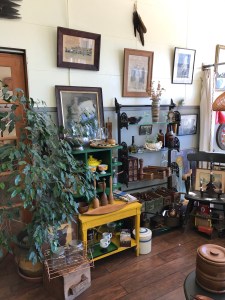 When Megan speaks of something she’s passionate about—her store, the museum, kids spending too much time on screens, or the lack of housing on the coast—her hazel eyes blaze. She’s articulate and quick to laugh, flashing a sly look whenever she makes fun of something or herself. As I listen, I understand why Fort Bragg once had a hard time holding onto her intense energy.
 Over the next 16 years, Megan and Ben settled into life in Petaluma. They bought a house and had two sons—Addison (9) and Arias (5). “As the boys grew older, I became uneasy about raising them in a suburban environment where there’s a disconnect with nature. I drove 15 minutes just to go to the park. I regularly took them to Fort Bragg where they could play in the forest and we could be at the beach within five minutes. They seemed happiest in the wild.
 During that time, Megan looked for a storefront in Fort Bragg. In November 2016, she was walking by the Larry Spring Museum and saw a slip of paper with Heather Brown’s phone number written on it. “I called and within twenty minutes, I had the keys.”

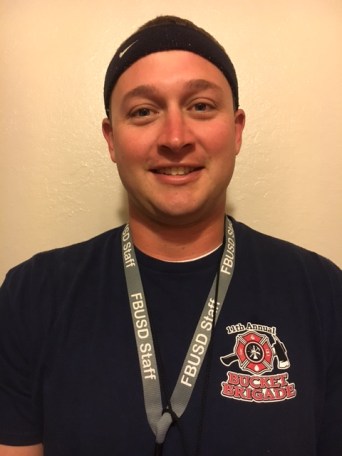 I’ve known Mark since he was a child, but don’t know him well. He had a good reputation, and I was always warmed by his delightful smile. Five years ago, when I heard he was hired to teach PE at
  Mark went on to
  In 2011, Mark applied for and got the PE position. During the school year, Mark’s workday begins at six-thirty and often doesn’t end until eight at night. “I was the assistant baseball coach for four years. After that, I began assisting with football. Three years ago, I became the Athletic Director.”
 This past summer, Mark married long-time girlfriend Jessica Alguinaldo. “We dated in high school. When I went away to college, she was starting her junior year, and it was hard to stay together. We broke up in 2005, but started dating again in 2010 when she graduated from Oregon State and moved back to Fort Bragg.” Jessica works as an audiologist for Audiology Associates. She runs their three offices—Mendocino, Santa Rosa and Mill Valley.



 A year later, she returned to her previous job in Sacramento. “In January 2003, I moved back to Fort Bragg. For a boy,” she added with a laugh. This boy was Vince Caccamo who she’d known from kindergarten, but lost touch with after high school. He’d graduated from UC Berkeley and returned to work in his dad’s construction business. “I was home for a visit in 2002 and ran into him at the Caspar Inn. I remember I was wearing jeans sprinkled with pink glitter.” She smiled at the memory.
 After she moved to Fort Bragg, she worked with her dad and found she really liked it. “My favorite time of year is prom when guys get fitted for tuxedos. There are so few chances for them to get dressed up, which makes this time of year so special.” While dating Vince, she took classes at the local College of the Redwoods campus. In 2005, she enrolled in Humboldt State. “I went to school during the week and came home on weekends to work. I finished my BA in Cultural Anthropology in three semesters.”
 In February 2015, she decided to take Reynolds’ Men’s Wear back to its roots and spin off the women’s section into its own store across the street—Wren’s (a play on Women’s Reynolds). Then came the shock of her life—a diagnosis of non-Hodgkin’s lymphoma. The new store opened in April. A week later, she discovered she was pregnant.


 At the age of 27, Gus is like a man from another era. He is extraordinarily polite, respectful, quietly self-confident, and a hard worker. In high school, he entertained the idea of going to college and majoring in marine biology. By his senior year, he realized this wasn’t his passion, and he didn’t want to waste money on an education he might never use. At the age of 18, he went to work for a building contractor. After two months, he was recruited by Williams Electric in Mendocino where he remained for nine years. “I learned to wire anything from a small shed to a smart home that can be controlled with a cell phone.” Through this experience, he discovered his true passion—electricity.
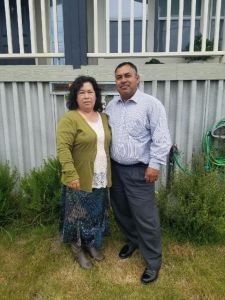 Gus’s work ethic is inherited from his parents. When he was a year old, they moved to Fort Bragg from Mexico to work in the fish processing industry. “This was in 1990 when fishing was booming,” he said. “My parents made minimum wage, but sometimes worked 40 to 50 hours of overtime a week. For a number of years, we lived in an apartment with another family while my parents saved enough money to buy a house.”
 Gus’s wife Sierra works for Harvest Market. They’ve been married five years. “I met her in 2011 when our local Jehovah’s Witness Kingdom Hall needed a major renovation. Three hundred volunteers from throughout the state showed up and over the course of two weekends, we gutted the place and rebuilt it.” Sierra, who lived in Chico at the time, was one of those volunteers.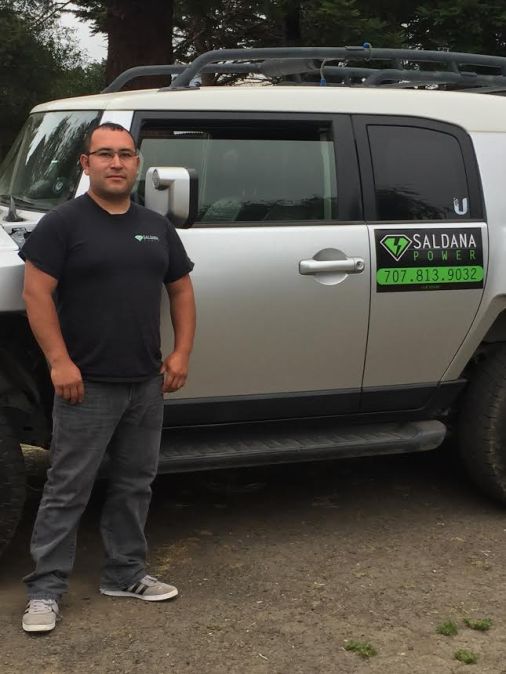
 It Happened at Purity